Best Battery Monitor for a 12V Van Build
The Victron SmartShunt 500A at $87.85 is the best battery monitor for most 12V builds. A 12V LiFePO4 pack only moves from about 13.4V at full to 12.8V at 10 percent remaining, so voltage cannot tell you state of charge and a shunt that counts amp-hours in and out is the only honest reading.
A battery monitor is the cheapest component in a 12V build and the one that changes how you use the whole system, because it replaces guessing with a number. For most builds the answer is the Victron SmartShunt 500A at $87.85, because voltage alone tells you almost nothing about a lithium battery, and a shunt that counts amp-hours in and out is the only measurement that actually reflects what is left.
State of charge is the percentage of a battery's usable capacity still available, and a shunt-based monitor calculates it by counting every amp-hour that goes in and comes out. That is fundamentally different from reading terminal voltage, which is an inference, and on lithium it is an inference with almost no information in it.
Best battery monitors by build stage

AILI TR16 Shunt Battery Monitor (500A, 8 to 120V)
The cheapest honest amp-hour counter on the market. No app and no logging, but it counts current in and out through a real shunt, which is the only measurement that tells you a lithium state of charge.
Best for: A first monitor on a single-battery build
Check price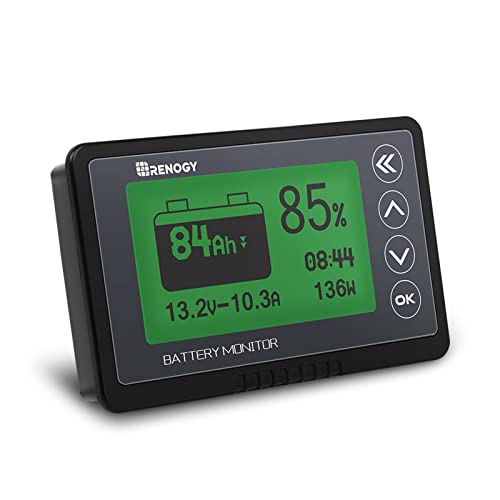
Renogy 500A Battery Monitor with Shunt and Wired Display
A wired panel rather than a phone app, which some people genuinely prefer because the number is visible without unlocking anything. Same shunt principle, same accuracy class.
Best for: Builds that want a permanent readout on a panel
Check price
ANCEL BM1000 Bluetooth Battery Monitor with 400A Smart Shunt
App-based monitoring at roughly two thirds the price of the Victron equivalent, with per-chemistry profiles including LiFePO4. The app is less polished, which is the whole of the trade.
Best for: App monitoring on a tighter budget
Check price
Victron SmartShunt 500A Battery Monitor (Bluetooth)
Voltage alone tells you almost nothing about a lithium battery because the discharge curve is nearly flat. This counts amp-hours in and out and it is the piece of the system that turns guessing into knowing.
Best for: The default monitor on any lithium build
Check price
Victron SmartShunt IP65 500A Battery Monitor (Bluetooth)
The sealed version, for a shunt that lives under the vehicle, in a wheel well or anywhere it will see spray and dust. Ten dollars more than the standard unit and worth it in any exposed location.
Best for: Under-vehicle and exposed battery compartments
Check priceVictron BMV-712 Smart Battery Monitor with Display Head
The SmartShunt plus a panel-mount display head, for a build where the state of charge should be readable from the bed rather than from a phone. Amazon stock on the display-head kit is inconsistent, so this opens a scoped search.
Best for: Fixed installs that want a dedicated gauge on a wall panel
Find on AmazonPrices change often, confirm on Amazon. Products without a direct listing sell mainly through dealers, so those links open a scoped Amazon search. As an Amazon Associate we earn from qualifying purchases.
Why does voltage fail as a fuel gauge on lithium?
Because LiFePO4 cells hold a nearly constant voltage across most of their discharge. That flat curve is the chemistry working exactly as intended, since a device running from the battery sees a stable supply from full to nearly empty. It is also what makes a voltmeter useless as a fuel gauge.
Compare the two chemistries at rest, with no load and no charge applied. A 12V LiFePO4 pack sits around 13.4V at full and only reaches about 12.8V at 10 percent remaining, so the entire useful range spans roughly half a volt. A 12V AGM covers nearly a full volt over the same range, which is why the old habit of reading a voltmeter works acceptably on lead acid and fails completely on lithium.
It gets worse in use. Under a load, terminal voltage sags; under charge, it rises; both effects are larger than the entire spread between 100 and 20 percent state of charge. Reading a lithium bank at 13.1V under a fridge load tells you nothing about whether you have 80 amp-hours or 20. That is the whole case for a shunt, and the battery chemistry comparison chart shows how differently the two chemistries behave.
| State of charge | LiFePO4 resting volts | AGM resting volts | Usable Ah from 100Ah LiFePO4 | Usable Ah from 100Ah AGM |
|---|---|---|---|---|
| 100% | 13.4 | 12.7 | 85 | 50 |
| 90% | 13.3 | 12.6 | 75 | 40 |
| 70% | 13.2 | 12.4 | 55 | 20 |
| 50% | 13.1 | 12.2 | 35 | 0 |
| 30% | 13.0 | 12.0 | 15 | 0 |
| 20% | 12.9 | 11.9 | 5 | 0 |
| 10% | 12.8 | 11.8 | 0 | 0 |
Resting voltages are typical published figures and vary by manufacturer and temperature, so treat them as the shape of the curve rather than a calibration. They apply only after the battery has rested with no load and no charge. Usable amp-hours count down from the safe floor of each chemistry: 15 percent for LiFePO4 at an 85 percent depth of discharge, and 50 percent for AGM. Notice that the entire LiFePO4 column moves 0.6V while the AGM column moves 0.9V, and that a single volt of measurement error covers the whole lithium range.
Which battery monitor should most builds buy?
The Victron SmartShunt 500A at $87.85. It has no display of its own, which is exactly the design decision that makes it the default pick: no panel to cut into a wall, no cable to run to a display, just a shunt in the negative cable and a phone app. In a vehicle where every surface is contested, a monitor that occupies no surface at all is worth something real.
What it gives you is the piece of the system that turns guessing into knowing: amp-hours consumed, current in and out right now, time to empty at the present rate, and a history you can look back at. The history is the underrated half. It is how you discover that something is drawing two amps overnight that should not be, or that your solar stopped contributing at noon because the bank was already full.
If you prefer a fixed readout, the Renogy 500A monitor with wired display at $70.06 does the same amp-hour counting with a panel you can glance at without unlocking a phone, and it is the cheapest of the well-supported options. The ANCEL BM1000 at $91.99 is app-based with per-chemistry profiles including LiFePO4, at roughly two thirds the price of the Victron equivalent when it is discounted, with a less polished app as the whole of the trade.
Is the cheapest monitor good enough?
Largely, yes, and that is worth saying plainly. The AILI TR16 shunt monitor at $42.00 is the cheapest honest amp-hour counter on the market. It has no app and no logging, and it counts current in and out through a real shunt, which is the measurement that matters. On a single-battery build with one charge source, it does the job the $87 unit does.
What you give up is diagnosis rather than measurement. Without history you can see that the bank is at 60 percent; you cannot see when it got there or what took it. Without an app you cannot check the system from the front seat or from a campsite table. And without configurable chemistry profiles, the state of charge estimate resets and drifts differently, so you will recalibrate by charging to full more often.
The honest recommendation is that any shunt beats no shunt by a wide margin, and the step from $42 to $87 buys information rather than accuracy. If the budget is tight and the choice is between a cheap monitor and no monitor, buy the cheap monitor. If the choice is between a good monitor and one more solar panel, buy the monitor, because it will tell you whether you needed the panel.
How do you install a shunt without corrupting the reading?
There is exactly one rule and it accounts for most of the bad readings people report: nothing may connect to the battery side of the shunt except the battery. Every load, every charge source, the inverter negative, the DC-DC charger negative and the chassis ground all attach to the system side. Anything wired past the shunt is current the monitor cannot see, and it will drift the count silently rather than reporting an error.
In practice that means the shunt goes directly on the battery negative post, or on a very short cable from it, with a negative busbar on the far side collecting everything else. A pair of 250A busbars at $21.55 makes this tidy and torqueable and removes the habit of stacking six ring terminals on one post, where the bottom terminal loses clamping force first and heats up under load.
Size the negative cable the same as the positive, because it carries the same current. Crimp the lugs with a proper tool: a 10 ton hydraulic lug crimper at $46.99 is the cheapest safety item in the build, and you cannot hand-crimp a 2 AWG lug properly. Verify the finished install against a digital clamp meter at $35.99: if the meter reads a current the monitor does not, you have a load on the wrong side of the shunt. Full layout sequence in the 12V wiring and fusing guide.
What do you actually do with the numbers?
Three things, and all of them change how the build gets designed. First, you learn your real daily consumption instead of the figure you estimated from labels. Appliance ratings are peak figures and duty cycle is what empties a battery, so a fridge rated at 45W might average 20. Feed the measured number into the power consumption calculator and the battery sizing stops being a guess.
Second, you find the parasitic draw. Almost every build has one: an inverter left on with nothing plugged in taking 15 to 25 watts, a stereo head unit that never truly sleeps, a controller in a fault state. At 20 watts continuous that is 480 watt-hours a day, roughly 37 amp-hours at 12.8V, which is most of a fridge day disappearing into nothing.
Third, you size the next purchase correctly. Knowing you consume 55 amp-hours a day and recover 40 from solar tells you exactly what to buy next, and whether the answer is another panel, a DC-DC charger or a second battery. Work the bank size in the battery bank calculator and match it against the packs in the lithium battery roundup.
Who should not buy the expert tier?
Do not buy the Victron SmartShunt IP65 at $98.94 if your shunt lives in a dry cabinet inside the vehicle. The sealed case is worth the eleven dollar premium in an under-vehicle box, a wheel well or an open truck bed, where it will see spray and dust. Inside a van, behind a panel, you are paying for protection the location already provides.
Do not buy the Victron BMV-712 unless you genuinely want a dedicated gauge on a wall panel. It is the same shunt with a display head, and that display head costs a hole in a cabinet, a cable run and more money than the SmartShunt. It is the right answer for a fixed build where the state of charge should be readable from the bed without reaching for a phone, and the wrong answer for everyone else. Amazon stock on the display-head kit is inconsistent, so that link opens a scoped search.
And do not buy a monitor at all before you have fused the system properly. A monitor tells you what is happening; it protects nothing. If the choice is between a shunt and a correctly sized terminal fuse, fit the fuse first, every time. The monitor is the second purchase, not the first.
What do people get wrong with battery monitors?
- Wiring a load to the battery side of the shunt. That current is invisible, and the count drifts without any warning that it is wrong.
- Never charging to full. Shunt monitors resynchronise their count at a full charge, so a bank that never reaches absorption slowly loses calibration.
- Setting the wrong battery capacity. The monitor calculates percentage from the capacity you told it, so an incorrect figure produces a confident, wrong number.
- Trusting a voltmeter on lithium. Half a volt covers the entire usable range, and load and charge shift it further than that.
- Buying a small shunt. Peak current sets the rating, and an inverter alone can pull 185A.
- Undersizing the negative cable. It carries exactly the same current as the positive and deserves the same conductor and the same crimp.
Frequently asked questions
Why can I not just read battery voltage to see state of charge?
Because the LiFePO4 discharge curve is almost flat. A 12V lithium pack sits near 13.4V when full and only falls to about 12.8V at 10 percent remaining, so the entire usable range is compressed into roughly half a volt, and any load or charge on the system shifts it further. Lead acid spans nearly a full volt across the same range, which is why voltage guessing works there and fails on lithium.
What does a battery shunt actually measure?
A shunt is a precision low-resistance strip fitted in the negative cable, so every amp entering or leaving the battery passes through it. The monitor measures the tiny voltage across that strip and converts it to current, then integrates current over time to count amp-hours in and out. That running total is a real measurement of energy moved, not an inference from terminal voltage.
Where does the shunt have to be installed?
On the negative side, between the battery negative terminal and everything else in the system. Nothing may connect to the battery side of the shunt except the battery itself, because any load wired past it is invisible to the monitor and silently corrupts the count. That includes the chassis ground, the inverter negative, the charger negative and any factory accessory someone tapped in earlier.
Do I need a 500A shunt for a 100Ah battery?
The rating is a ceiling, not a target, and 500A costs almost nothing more than 300A. It matters because peak current, not average current, sets the requirement: a 2000W inverter pulls roughly 185A, and a winch or a starter draw on a shared bank goes far higher. Buy the 500A version and it will still be correct after you add an inverter.
Does a battery monitor drain the battery?
Barely. A shunt-based monitor typically consumes well under a tenth of an amp, which is under 2.4 amp-hours a day even at the high end and usually far less. That is a rounding error against a fridge at 30 to 45 amp-hours daily. The reading it gives you saves far more than it costs by stopping you from over-discharging or over-buying capacity.
Will the battery Bluetooth app replace a shunt?
Not fully. A smart battery reports what its own management system sees, which is that battery only, and its state of charge estimate is often derived rather than counted. A shunt sees the whole bank plus every charge source and every load together, including the ones outside the battery. On a single smart battery the app is a reasonable start; on any bank with parallel packs it is not.
Electrical safety: 12V is low voltage but not low energy. A lithium house battery can push several hundred amps into a short circuit, and undersized or unfused cable is one of the most common causes of vehicle fires in DIY builds. Every circuit must be fused at the source of power, within a few inches of the battery terminal, at or below the ampacity of the smallest conductor it protects. Size cable for voltage drop as well as ampacity, torque terminals to specification, and have a lithium installation inspected by a qualified installer before it carries load. The figures on this page are researched guidance, not a substitute for ABYC E-11 or your component manufacturer's installation manual.
How we choose: we compare published manufacturer specifications, standards documents including ABYC E-11, and verified owner reviews. We do not test gear in person. Vehicle payload, roof load and charging limits vary by model and year, so confirm yours against the door jamb sticker and the owner's manual rather than any number published here.
Totalling your own build weight against your payload? The Overland Build & Power Planner is the paid version of these pages: 8 printable worksheets you fill in with your own numbers, plus the full PDF, $29.