12V Fridge vs Cooler: The Break-Even Is About 10 Trips
A 12V compressor fridge pays for itself against ice in about ten trips at the entry price, because a 50 quart cooler burns roughly $25 of ice on a four night warm-weather trip and loses about 27 of its 50 quarts to that ice. A 45 litre fridge draws about 32 amp-hours a day at 80F ambient. Thermoelectric coolers are not a real option: they hold only about 20F below ambient and draw 4 to 5A continuously.
There are three ways to keep food cold in a vehicle and only two of them work. Buy a 12V compressor fridge if you camp more than about ten nights a year, keep a good ice cooler if you camp two or three nights a year near a store, and do not buy a thermoelectric cooler at all. The compressor fridge breaks even against ice cost in roughly ten trips at the entry price, and it gives back the third of the cooler that ice was occupying.
Start with the mechanism, because it explains everything downstream. A compressor fridge is a small version of the appliance in your kitchen: it moves heat out of an insulated box using a refrigerant cycle, so it can hold any setpoint you ask for regardless of how hot it is outside, and it only runs when the temperature drifts. An ice cooler stores cold rather than making it, so it is a countdown from the moment you close the lid. A thermoelectric cooler uses the Peltier effect to pump a small amount of heat across a semiconductor junction, and its capability is fixed at a modest offset from ambient.
What does ice actually cost per trip?
Ice is the running cost people never add up, because it arrives five dollars at a time. At $5 per 10 pound bag, with two bags to pre-chill and load a 50 quart cooler and roughly one bag a day after that in warm weather, the arithmetic looks like this.
| Trip length | Bags of ice | Ice cost | Volume and hassle |
|---|---|---|---|
| 2 nights | 3 | $15 | 27 qt of 50 lost to ice |
| 3 nights | 4 | $20 | 27 qt of 50 lost to ice |
| 4 nights | 5 | $25 | 27 qt of 50 lost to ice |
| 7 nights | 8 | $40 | plus two resupply detours |
| 10 nights | 11 | $55 | plus three resupply detours |
Twenty-five dollars for a four night trip is the number to hold on to. But the money is the smaller half of the cost. Twenty pounds of cubed ice occupies roughly 18 quarts of packed volume, so a 50 quart cooler loaded for that trip is carrying something like 27 quarts of ice and meltwater and leaving 23 quarts for food. You are hauling a 50 quart box to get a 23 quart fridge, and the 23 quarts get progressively wetter.
Then there is the part nobody budgets: the detour. Once past about three nights, an ice cooler dictates your route, because you have to pass a store. That is a genuine constraint on where you can camp and how long you can stay, and for a lot of people it is the actual reason they buy a fridge rather than the arithmetic. Food loss belongs in the ledger too. One spoiled cook-out worth of meat is most of a bag-of-ice season.
How many trips before a fridge pays for itself?
Take $25 of ice per four night trip as the running cost of the cooler and divide it into the purchase price of each fridge. This ignores the cooler's own purchase price, which flatters the cooler, and it ignores food loss and detours, which flatters it further.
| Fridge | Price | Trips to break even | Years at 10 trips a year | Typical Ah/day at 80F |
|---|---|---|---|---|
| BougeRV CRPRO 30 quart | $246.99 | 10 | 1.0 | 24 |
| Alpicool CHS55 42 quart | $299.99 | 12 | 1.2 | 30 |
| ICECO VL45 45 litre | $698.00 | 28 | 2.8 | 32 |
| Dometic CFX2 45 litre | $879.99 | 35 | 3.5 | 26 |
| ARB Zero 47 quart | $1,136.00 | 45 | 4.5 | 28 |
| Dometic CFX5 75 litre dual zone | $1,282.49 | 51 | 5.1 | 48 |
The BougeRV CRPRO 30 at $246.99 breaks even in about ten trips, which is one season for anyone who camps most months. That is a genuinely short payback for a purchase that also removes the drained meltwater, the soggy packaging and the resupply stops. At 30 quarts it suits two people over a long weekend if you shop for the space you have.
Notice the last column, because it complicates the story in the fridge's favour. The Dometic CFX2 45 at $879.99 takes 35 trips to break even against ice, and it draws fewer amp-hours per day than boxes costing a third as much. Better insulation and a better lid seal are what that money buys, and in hot climates that difference compounds into a smaller battery bank and a smaller array, which is real money that does not show up in a break-even table.
Also notice that a cooler is not free. A decent rotomoulded 50 quart cooler is $50 to $350 depending on brand, and the premium ones cost as much as the entry-level fridge while still needing ice forever. If you are pricing a $300 cooler against a $247 fridge, the fridge is cheaper on day one and then keeps winning.
How many amp-hours does a fridge actually need?
This is the number that sizes the rest of the build, and it depends far more on ambient temperature than on the fridge's nameplate wattage. A compressor fridge does not draw its rated current all day; it draws it during compressor runs, and ambient temperature sets what fraction of each hour that is. The figures below are for a 40 to 45 litre unit and agree with the fridge power draw chart.
| Ambient F | Ambient C | Fridge setpoint, Ah/day | Freezer setpoint, Ah/day | Duty cycle, fridge | Duty cycle, freezer |
|---|---|---|---|---|---|
| 60 | 16 | 18 | 30 | 18% | 30% |
| 70 | 21 | 24 | 40 | 24% | 40% |
| 80 | 27 | 32 | 54 | 32% | 54% |
| 90 | 32 | 42 | 70 | 42% | 70% |
| 100 | 38 | 54 | 88 | 54% | 88% |
| 110 | 43 | 68 | 110 | 68% | runs nearly continuously |
Read the jump from 80F to 100F: 32 amp-hours a day becomes 54, an increase of nearly 70 percent for a 20 degree change in the weather. That is why fridge power draw is the single most temperature-sensitive load in a vehicle and why a bank sized on a mild spring trip runs out at the height of summer. Against a 100Ah LiFePO4 pack with 85 usable amp-hours, 32 amp-hours a day is about two and a half days of autonomy and 54 is about a day and a half.
Three practical levers move those numbers a long way without spending anything. Ventilation first: a fridge in a sealed cabinet is re-breathing its own waste heat, and giving the condenser a real air path is worth a noticeable fraction of the daily figure. Shade second, because a fridge in direct sun through a window behaves like one in a much hotter ambient. And setpoint third, because running the freezer compartment when nothing in it needs freezing costs 60 to 70 percent more than running it as a fridge.
Size the bank against the number for your climate rather than a generic one. Feed the figure into the power consumption calculator with your lighting, fan and charging loads, then into the battery bank calculator. On a build where the fridge is the whole load, a Dometic PLB15 Portable Lithium Battery lives next to it and turns the fridge into a self-contained system without cutting into the vehicle.
Why should you dismiss thermoelectric coolers?
Because they lose on every axis at once, and they are still widely sold to people who assume that anything with a 12V plug and a fan is a fridge. A Peltier cooler pumps heat across a semiconductor junction, and the practical result in a consumer box is a temperature offset of only about 20F below ambient.
Work through what that means. On a 90F afternoon, a thermoelectric cooler holds around 70F inside. Food safety guidance is to keep perishable food at or below 40F, so at 70F it is not preserving food, it is warming it slightly more slowly than the air would. On a 70F day it manages about 50F, which is still above the safe line. There is no ambient temperature at which it does the job a fridge does, except in weather cold enough that you did not need it.
Now the power. Because there is no thermostatic cycling in the way a compressor fridge cycles, a Peltier unit draws its 4 to 5 amps continuously whenever it is on. That is roughly 108 amp-hours a day, against 42 for a compressor fridge holding a genuinely cold box in the same 90F ambient. The thermoelectric cooler uses two and a half times the energy to do a fundamentally worse job. On a 100Ah lithium bank it would flatten the usable capacity in under a day.
| Comparison at 90F ambient | Compressor fridge | Ice cooler | Thermoelectric |
|---|---|---|---|
| Holds 37F in 90F ambient | Yes, indefinitely | For 1 to 2 days | No, it reaches about 70F |
| Daily amp-hours at 90F | 42 | 0 | 108 |
| Current draw pattern | Cycles, 40 to 45 percent duty | None | Continuous 4 to 5A |
| Can freeze food | Yes | No | No |
| Usable volume of a 50 quart box | 50 qt | 23 qt after ice | 50 qt |
| Running cost per 4 night trip | $0 | $25 of ice | $0 |
| Needs a battery system | Yes | No | Yes, a bigger one |
| Food safety | Reliable below 40F | Depends on ice remaining | Not food safe in heat |
| Purchase price | $247 to $1,282 | $50 to $350 | $60 to $150 |
The only honest use for a thermoelectric box is keeping already-cold drinks cool on a short drive in mild weather, with the engine running, where the alternative is nothing. Even then, an ice cooler does it better for less. If you own one, the money is spent and it will keep sandwiches cool on a day trip. Do not buy one, and do not run one from a house battery.
Which compressor fridge should you buy?
For most builds the ICECO VL45 at $698.00 is the best compressor per dollar in the middle of the range, because it uses a Secop compressor of the same class found in fridges costing considerably more, and this version ships with a magnetic 250Wh battery so it holds temperature through a stop with the engine off.
On a first build or a small cargo area, the BougeRV CRPRO 30 Quart 12V Refrigerator at $246.99 is a real compressor fridge at roughly the price of two seasons of ice. If you want a freezer compartment on an entry budget, the Alpicool CHS55 dual temperature at $299.99 gives you two zones, and the trade against premium units is insulation thickness, which shows up as higher daily amp-hours in heat.
In hot climates, insulation is worth more than any other feature, which is the case for the Dometic CFX2 45 at $879.99. For hard off-road use and remote travel, the ARB Zero 47 at $1,136.00 is built for corrugations rather than a driveway, and its low-voltage cutout is the feature that stops a fridge flattening a starter battery. Wire whichever you choose through a 50A Anderson connector rather than a cigarette socket, because that socket is the most common cause of fridge voltage complaints.
12V compressor fridges by build stage

BougeRV CRPRO 30 Quart 12V Refrigerator
A real compressor fridge, not a thermoelectric cooler, at roughly the price of two seasons of ice. 30 quarts is enough for two people over a long weekend if you shop for the space you have.
Best for: A first fridge, and small cargo areas
Check price
Alpicool CHS55 42 Quart Dual Temperature 12V Fridge Freezer
Dual zone at an entry price, so one side holds drinks and the other holds frozen food. The trade against premium units is insulation thickness, which shows up as higher daily amp-hours in heat.
Best for: Budget builds that still want a freezer compartment
Check price
ICECO VL45 45L Portable Refrigerator (Secop Compressor)
A Secop compressor, which is the same class of unit inside fridges costing considerably more. This version ships with a 250Wh magnetic battery, so it holds temperature through a stop with the engine off.
Best for: The best compressor per dollar in the middle tier
Check price
Dometic CFX2 45 Litre Portable Refrigerator and Freezer
Dometic’s insulation and lid seal are the reason these draw fewer amp-hours per day than cheaper boxes of the same volume. Over a week off-grid that difference is worth more than the purchase price gap.
Best for: Hot climates, where insulation quality decides your battery size
Check price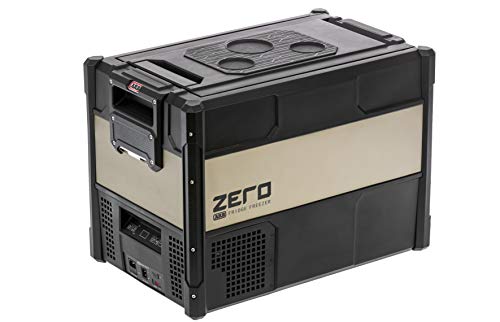
ARB Zero 47 Quart Single Zone Fridge Freezer
Built for corrugated dirt roads rather than a driveway, with a variable speed compressor and app control. Its low-voltage cutout protection is the feature that stops a fridge flattening a starter battery.
Best for: Serious off-road use and remote travel
Check price
Dometic CFX5 75 Litre Dual Zone Portable Refrigerator and Freezer
Fridge and freezer at full size in one cabinet. It also draws the most of anything here and takes a large chunk of both cargo space and payload, so size the battery bank around it first.
Best for: Families and long expeditions with frozen food
Check pricePrices change often, confirm on Amazon. Products without a direct listing sell mainly through dealers, so those links open a scoped Amazon search. As an Amazon Associate we earn from qualifying purchases.
Who should choose each, and who should not?
Choose a compressor fridge if you camp more than about ten nights a year, if any trip runs longer than three nights, if you travel anywhere hot, if you want frozen food, or if you already have or intend to build a 12V system. Choose it especially if you dislike planning a route around a store, because that is the constraint a fridge removes most completely.
Choose an ice cooler if you camp a handful of nights a year, always within reach of a shop, and have no 12V system at all. A good rotomoulded cooler needs no battery, no wiring, no fuse and no thought, it works in a rental vehicle, and it does not care about being left in storage for a year. That is a perfectly respectable answer and it costs nothing to run in amp-hours.
Who should not buy the expensive fridge: if your bank is a single 100Ah battery and your charging is a 100W panel, a 75 litre dual zone unit at $1,282.49 is a mistake, not an upgrade. It draws the most of anything in this category, it takes a large chunk of both cargo space and payload, and it will empty your bank faster than your array can refill it. A big fridge is a decision to build a bigger power system, and it should be made in that order. Read how to choose a 12V fridge before committing to a size.
What does a fridge need from the rest of the build?
A fridge is the load that turns a battery into a system, because it is the only thing in a vehicle that runs continuously whether you are there or not. Lighting stops when you sleep and phone charging stops when the phone is full, but a compressor cycles all night and all day while you are up a trail, which means it sets the size of everything else.
Storage first. Against a fridge drawing 32 amp-hours a day at 80F, a single 100Ah self-heating LiFePO4 pack with 85 usable amp-hours gives roughly two and a half days of fridge with nothing else running, which in practice is closer to a day and a half once lights, a fan and charging are included. That is enough for a weekend and not enough for a week, which is why the fridge decision and the charging decision are the same decision.
Charging second, and this is where builds usually get it wrong. A 50A DC-DC charger returns around 100 amp-hours from a two hour drive, which is three days of fridge recovered in an afternoon you were spending anyway. A 200W roof array returns around 59 amp-hours on a good summer day and about 23 in midwinter. Both are useful, and the alternator side is the one that keeps working when you park under trees to keep the vehicle cool, which is exactly when the fridge is working hardest.
Wiring third. A fridge is a motor load with a startup surge, so it is treated as a critical circuit: 12 AWG conductor, a 15A fuse at the source of power, and voltage drop kept under 3 percent because a compressor running on low voltage draws more current and gets hot. Terminate it in a 50A Anderson connector rather than a cigarette socket, which is the most common cause of a fridge that cuts out on low voltage while the battery is still half full.
Mounting last, and it is worth more than it sounds. Give the condenser a real air path, because a fridge in a sealed cabinet is re-breathing its own waste heat and paying for it in amp-hours every hour of every day. Keep it out of direct sun, strap it down so it cannot move on a corrugated road, and if it lives in a drawer, confirm the drawer still lets air move behind it when it is closed.
Where to go next
- How to choose a 12V fridge, for sizing, mounting and ventilation.
- Fridge power draw by temperature, for the full amp-hour grid.
- The 12V fridge roundup, with picks by build stage.
- The battery bank calculator, to size storage around the fridge figure.
- Power station versus DIY battery bank, which is the system the fridge has to run on.
- ARB Zero 47QT single zone fridge review, the single-product review.
- Dometic CFX2 45L review, the single-product review.
- ICECO VL60 dual zone fridge review, the single-product review.
- MaxxAir MaxxFan Deluxe review, the single-product review.
Frequently asked questions
How many trips before a 12V fridge pays for itself?
At $5 per 10 pound bag of ice and roughly five bags for a four night trip in warm weather, a cooler costs about $25 a trip to run. A 30 quart compressor fridge at $246.99 breaks even at about ten trips, which is one season for most people. A premium 45 litre unit at $879.99 takes around 35 trips, so roughly three seasons, and the case for it rests on insulation and durability rather than on ice savings.
How many amp-hours does a 12V fridge use per day?
For a 40 to 45 litre unit at a fridge setpoint, roughly 18 amp-hours a day at 60F ambient, 32 at 80F and 54 at 100F. Set the same box to freezer temperature and those figures rise by about 60 to 70 percent. Insulation quality moves the numbers by 20 to 30 percent either way, and a fridge in direct sun or in a sealed cabinet with no airflow behaves like one in a much hotter ambient.
Are thermoelectric coolers worth buying?
No, for vehicle use. A Peltier unit pulls only about 20F below ambient, so in 90F weather it holds around 70F, which is not food safe. It also draws 4 to 5 amps continuously with no duty cycle, which is roughly 108 amp-hours a day, against 42 for a compressor fridge doing a far better job in the same conditions. It is worse on temperature, worse on power and worse on food safety.
How much space does ice actually take?
More than people expect. Twenty pounds of cubed ice occupies roughly 18 quarts of packed volume, so a 50 quart cooler loaded for a four night trip is carrying about 27 quarts of ice and meltwater and leaving you 23 quarts for food. A 45 litre compressor fridge of similar external size gives you the whole interior, which is why a fridge often replaces a noticeably larger cooler.
What battery do I need to run a fridge?
For a single 100Ah LiFePO4 pack with 85 usable amp-hours, a fridge drawing 32 amp-hours a day gives you about two and a half days with no charging at all, and that is before lights and phone charging. In practice you pair it with charging rather than with storage: a 50A DC-DC charger returns 100 amp-hours from a two hour drive, which is three days of fridge in one afternoon.
Should I buy a fridge or a bigger cooler?
If you camp more than about ten nights a year, buy the fridge. Beyond the ice cost, it removes the resupply detours, the soggy food, the daily draining and the anxiety about what is still safe to eat on day four. If you camp two or three nights a year and always within reach of a store, a good rotomoulded cooler is a perfectly sensible answer and needs no electrical system at all.
Electrical safety: 12V is low voltage but not low energy. A lithium house battery can push several hundred amps into a short circuit, and undersized or unfused cable is one of the most common causes of vehicle fires in DIY builds. Every circuit must be fused at the source of power, within a few inches of the battery terminal, at or below the ampacity of the smallest conductor it protects. Size cable for voltage drop as well as ampacity, torque terminals to specification, and have a lithium installation inspected by a qualified installer before it carries load. The figures on this page are researched guidance, not a substitute for ABYC E-11 or your component manufacturer's installation manual.
How we choose: we compare published manufacturer specifications, standards documents including ABYC E-11, and verified owner reviews. We do not test gear in person. Vehicle payload, roof load and charging limits vary by model and year, so confirm yours against the door jamb sticker and the owner's manual rather than any number published here.
Totalling your own build weight against your payload? The Overland Build & Power Planner is the paid version of these pages: 8 printable worksheets you fill in with your own numbers, plus the full PDF, $29.