Best 12V Fridge for Overlanding and Van Builds
The ICECO VL45 at $698 is the best 12V fridge for most overland builds: a Secop compressor, 45 litres of usable space and a 250Wh magnetic battery so it holds temperature with the engine off. Budget roughly 30 to 45 amp-hours a day for a 45 quart fridge at 90F ambient.
A 12V compressor fridge is the item that changes what a vehicle is for. It is also the largest continuous load most builds ever carry, which makes it a battery decision disguised as a kitchen decision. For most people the answer is the ICECO VL45 at $698, because it uses a Secop compressor, the same class of unit found inside fridges costing considerably more, and ships with a 250Wh magnetic battery that holds temperature through a stop with the engine off.
A 12V compressor fridge is a refrigerator with a small DC-powered compressor and real refrigerant, not a cooler with a fan. That distinction is the whole category. A thermoelectric cooler can only pull a fixed number of degrees below ambient, so on a 95F afternoon it makes warm food slightly less warm. A compressor fridge holds 37F regardless of what the air outside is doing, and it does so by drawing amp-hours out of your battery bank.
Best 12V fridges by build stage

BougeRV CRPRO 30 Quart 12V Refrigerator
A real compressor fridge, not a thermoelectric cooler, at roughly the price of two seasons of ice. 30 quarts is enough for two people over a long weekend if you shop for the space you have.
Best for: A first fridge, and small cargo areas
Check price
Alpicool CHS55 42 Quart Dual Temperature 12V Fridge Freezer
Dual zone at an entry price, so one side holds drinks and the other holds frozen food. The trade against premium units is insulation thickness, which shows up as higher daily amp-hours in heat.
Best for: Budget builds that still want a freezer compartment
Check price
ICECO VL45 45L Portable Refrigerator (Secop Compressor)
A Secop compressor, which is the same class of unit inside fridges costing considerably more. This version ships with a 250Wh magnetic battery, so it holds temperature through a stop with the engine off.
Best for: The best compressor per dollar in the middle tier
Check price
Dometic CFX2 45 Litre Portable Refrigerator and Freezer
Dometic’s insulation and lid seal are the reason these draw fewer amp-hours per day than cheaper boxes of the same volume. Over a week off-grid that difference is worth more than the purchase price gap.
Best for: Hot climates, where insulation quality decides your battery size
Check price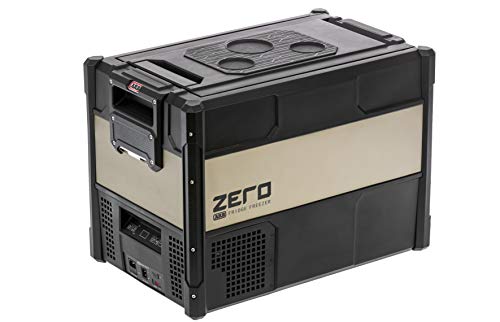
ARB Zero 47 Quart Single Zone Fridge Freezer
Built for corrugated dirt roads rather than a driveway, with a variable speed compressor and app control. Its low-voltage cutout protection is the feature that stops a fridge flattening a starter battery.
Best for: Serious off-road use and remote travel
Check price
Dometic CFX5 75 Litre Dual Zone Portable Refrigerator and Freezer
Fridge and freezer at full size in one cabinet. It also draws the most of anything here and takes a large chunk of both cargo space and payload, so size the battery bank around it first.
Best for: Families and long expeditions with frozen food
Check pricePrices change often, confirm on Amazon. Products without a direct listing sell mainly through dealers, so those links open a scoped Amazon search. As an Amazon Associate we earn from qualifying purchases.
How much power does a 12V fridge actually use?
Published draw figures are the current the compressor pulls while it is running, typically 4 to 6 amps on a mid-size unit. That number tells you almost nothing on its own, because the compressor is not running most of the time. What empties a battery is duty cycle: the fraction of each hour the compressor spends working to hold the setpoint.
Duty cycle is set by three things, in order of importance. Ambient temperature comes first, because the compressor is fighting the difference between the box interior and the air around it. Insulation thickness and lid seal come second, and they are the reason two 45 litre fridges can differ by a third in daily consumption. How often the lid opens comes third, and it matters more on a hot day than a cold one because cold air falls straight out of a chest-style box the moment the lid comes up.
In round numbers, budget 20 to 30 amp-hours a day for a 45 quart fridge in mild weather and 30 to 45 at 90F ambient. A 75 litre dual zone unit running a real freezer compartment in the desert can reach 60 to 70. Those are the figures to size a battery bank against, and the fridge power draw by temperature chart sets out the whole spread.
| Fridge | Capacity | Zones | Compressor | Typical Ah per day | Price |
|---|---|---|---|---|---|
| BougeRV CRPRO 30 | 30 qt / 28 L | Single | Entry DC | 18 to 30 | $246.99 |
| Alpicool CHS55 | 42 qt / 40 L | Dual | Entry DC | 28 to 50 | $299.99 |
| ICECO VL45 | 45 L / 48 qt | Single | Secop | 25 to 40 | $698.00 |
| Dometic CFX2 45 | 45 L / 48 qt | Single | Variable speed | 22 to 36 | $879.99 |
| ARB Zero 47 | 47 qt / 44 L | Single | Variable speed | 22 to 36 | $1,136.00 |
| Dometic CFX5 75DZ | 75 L / 79 qt | Dual | Variable speed | 40 to 70 | $1,282.49 |
Capacities and compressor types are the manufacturers' published specifications. The amp-hour ranges are researched typical figures for a 12V system across mild to hot ambient conditions, with the lower end representing shaded 70F use and the upper end 90F or above in a closed vehicle. Your own figure depends on ventilation, sun exposure and how often the lid opens. Prices move, so confirm before ordering.
Which 12V fridge should most people buy?
The ICECO VL45 at $698 is the best compressor per dollar in the category. Secop, formerly Danfoss, makes the compressor that premium brands have used for years, and putting it in a fridge at this price is the single reason this unit keeps appearing in serious builds. A better compressor is not about noise or looks; it modulates more intelligently, which is what keeps duty cycle and therefore amp-hours down.
The included 250Wh magnetic battery is the part people underrate. It means the fridge holds temperature through a night at a trailhead without touching the house bank, or through a ferry crossing, or through the two hours your vehicle is at a garage with the battery disconnected. It effectively gives the fridge its own small house system, which is exactly the thing a first-time builder has not yet installed.
The alternative at the same tier is the Dometic CFX2 45 at $879.99. You are paying roughly $180 more for insulation and lid sealing that are genuinely better, and in hot climates that difference shows up as a smaller battery bank. Over a week off-grid, a fridge that draws eight fewer amp-hours a day is 56 amp-hours you did not have to buy, store and charge. That is most of a 100Ah battery.
Does the entry tier actually work?
Yes, with two caveats. The BougeRV CRPRO 30 at $246.99 is a real compressor fridge, not a thermoelectric cooler, at roughly the price of two seasons of ice. Thirty quarts holds enough for two people over a long weekend if you shop for the space you actually have rather than emptying a home refrigerator into it.
The Alpicool CHS55 at $299.99 gives you dual zones at an entry price, so one side holds drinks and the other holds frozen food. The trade against premium units is insulation thickness, and that shows up directly as higher daily amp-hours in heat. If your build has a single 100Ah battery and no solar, a thirstier fridge is not a small compromise, it is the difference between three days off-grid and two.
The second caveat applies to both: check the low voltage cutout settings before you rely on them. Entry fridges usually offer low, medium and high protection levels, and the default is often the lowest, which will happily take a starting battery down to a voltage it cannot crank from. Set it to medium at least, and read the how to choose a 12V fridge guide for what else separates the tiers before you commit.
How big a battery bank does a fridge need?
Work from days of autonomy, meaning the number of days you want to run with no charging at all. Multiply your daily fridge draw by that number, add the rest of the load, then divide by usable depth of discharge. LiFePO4 is safely usable to about 80 to 90 percent, so a 100Ah lithium battery gives you 80 to 90Ah. AGM is usable to 50 percent, so a 100Ah AGM gives you 50Ah, which is why lithium at twice the price is often cheaper per usable amp-hour.
Put real numbers on it. A fridge at 40Ah a day plus lights and charging at 15Ah a day is 55Ah daily. Two days of autonomy is 110Ah of usable capacity, which is a 200Ah AGM bank or a single 100Ah lithium plus a little charging. Three days is 165Ah usable, which is two 100Ah lithium batteries. Run your own combination through the battery bank calculator rather than guessing at a round number.
A roof fan changes this arithmetic more than people expect, because a fridge venting into a hot sealed vehicle is fighting its own exhaust. A MaxxFan Deluxe at $343.31 draws roughly 3A on high and well under 1A on low, and dropping interior temperature by ten degrees cuts fridge duty cycle measurably. Ventilation is usually cheaper in amp-hours than the cooling it saves.
Who should not buy the expert tier?
Do not buy the Dometic CFX5 75DZ at $1,282.49 unless you have already sized a battery bank around it. At 40 to 70 amp-hours a day it is the largest single load in almost any build it goes into, and it also consumes a large piece of both cargo space and payload. Two people on weekend trips do not need 75 litres, and the correct order of operations is fridge size after battery capacity, never before.
Do not buy the ARB Zero 47 at $1,136 if your driving is pavement and graded forest road. What you are paying for is a unit engineered for corrugated dirt at speed: mounting, sealing and compressor isolation built for vibration that kills cheaper fridges. That is real engineering and it is wasted money on a vehicle that never sees it. The ICECO delivers the same temperature for $438 less.
Do not buy any premium fridge before you have solved charging. A $1,100 fridge on a 100Ah battery with no solar and no DC-DC charger is a fridge that stops working on day two. Fix the input side first, then upgrade the box. If you are still deciding whether you need a compressor fridge at all, the 12V fridge versus cooler comparison is the honest starting point.
What do people get wrong when buying a 12V fridge?
- Buying on volume alone. Insulation quality decides daily amp-hours, and daily amp-hours decide how much battery you have to buy and carry.
- Wiring it to the starter battery. A fridge is a house load. Give it a house battery, or at minimum a low voltage cutout set high enough to protect the crank.
- Running it through an inverter. A 12V fridge on a 12V system should be wired in DC. Going DC to AC and back throws away roughly 15 percent for no benefit.
- Boxing it in. A compressor needs airflow at the vent, and a sealed drawer turns a modest load into a large one.
- Loading it warm. Pulling room-temperature groceries down to setpoint is often the biggest single draw of the whole trip. Pre-cool at home on shore power.
- Undersizing the circuit. Fridges are a small continuous load, but the run still needs a correctly sized fuse at the source of power and a cable rated above it.
Once the fridge is chosen, everything downstream falls into place: measure its real draw with a clamp meter over a full day, feed that number into the power consumption calculator, and size the battery and the charging around the answer. A fridge is not the end of a build. It is the number the rest of the build is designed against.
Frequently asked questions
How many amp-hours does a 12V fridge use per day?
A 45 quart compressor fridge draws roughly 30 to 45 amp-hours a day at 90F ambient, and closer to 20 to 30 in mild weather. The compressor itself pulls about 4 to 6 amps while running, so the figure that matters is duty cycle rather than rated draw. Insulation quality, direct sun on the lid and how often you open it move that number more than brand ever does.
Is a 12V compressor fridge better than a cooler with ice?
For anything past two days, yes, decisively. A compressor fridge holds a set temperature indefinitely, never floods your food with meltwater, and does not need an ice run every other day. The cost is roughly 30 to 45 amp-hours a day and a battery big enough to supply it. A cooler is still the right answer for a single overnight or a trip where you have no house battery at all.
What size 12V fridge do I need?
Two people on a long weekend fit comfortably in 30 to 45 quarts if you shop for the space rather than filling it from a home refrigerator. Two people for a week, or any trip with frozen food, wants 45 to 60 litres. Above about 75 litres you are into family and expedition territory, where the fridge becomes the largest single load in the build and the battery bank has to be sized around it first.
Will a 12V fridge flatten my starter battery?
It can, and that is the specific reason to wire it to a house battery rather than the vehicle. If you must run one from the starting battery, use a fridge with a low voltage cutout set to the medium or high setting, which shuts the compressor off before the battery drops too far to crank. Better fridges make that cutout adjustable, and it is the single most useful protective feature in the category.
Do dual zone fridges use more power than single zone?
Yes, but not because there are two compartments. They use more because one of those compartments is usually held at freezer temperature, and the further you pull below ambient the harder the compressor works. A dual zone unit running both sides as a fridge draws about the same as a single zone of the same volume. Run the freezer side only when you actually need it frozen.
Can I run a 12V fridge straight from a portable power station?
Yes, and it is the cleanest way to start. Use the 12V output rather than an AC outlet and an adapter, because going DC to AC and back to DC throws away roughly 15 percent of the energy for nothing. A 1kWh station carries about 80 amp-hours at 12.8V, which is roughly two days of fridge with nothing else plugged in.
How we choose: we compare published manufacturer specifications, standards documents including ABYC E-11, and verified owner reviews. We do not test gear in person. Vehicle payload, roof load and charging limits vary by model and year, so confirm yours against the door jamb sticker and the owner's manual rather than any number published here.
Totalling your own build weight against your payload? The Overland Build & Power Planner is the paid version of these pages: 8 printable worksheets you fill in with your own numbers, plus the full PDF, $29.