Pure Sine vs Modified Sine Inverter: What Actually Breaks
Buy pure sine. Modified sine is a stepped approximation whose harmonics make induction motors run hot and draw 10 to 20 percent more current, cause some laptop and tool chargers to refuse or degrade, reduce effective microwave power and put an audible buzz through audio equipment, and medical devices such as CPAP machines must never see it. The price gap at 2000W is now a few tens of dollars.
This is the least balanced comparison on the site, and it should be. Buy a pure sine inverter. Modified sine is only correct if every AC load you will ever run is purely resistive, and the price gap that used to justify the compromise has largely disappeared. Everything with a motor in it runs hot and draws more current on a stepped waveform, a meaningful fraction of modern chargers reject it, and medical devices must never see it at all.
Start with what the two waveforms actually are, because most explanations stop at a picture of a smooth curve and a picture of a staircase. Mains AC is a sinusoid: voltage swings smoothly from positive peak through zero to negative peak, 60 times a second. Every appliance you can buy was designed with that shape assumed, and a surprising number of them depend on details of it that are easy to overlook: where the zero crossing falls, how sharp the peak is, and how much energy sits at frequencies other than 60Hz.
A modified sine inverter does not produce that curve. It switches the output between a positive level, zero and a negative level, holding each for a calculated interval so that the RMS voltage comes out at the correct 120V. The average is right. The shape is a staircase with vertical edges, and a vertical edge in the time domain is a large amount of energy spread across harmonics of 60Hz. Those harmonics are the entire story of what goes wrong.
Which appliances actually fail on modified sine?
Sorted by how badly, and with the reason rather than just a verdict, because the reasons predict what will happen to a device that is not on this list.
| Load | Pure sine | Modified sine | Why |
|---|---|---|---|
| Incandescent bulbs and heating elements | Fine | Fine | A resistor does not care about waveform shape |
| Kettle, toaster, hair dryer on high | Fine | Fine | Purely resistive, the one clean win for modified sine |
| Induction motors: pumps, fans, compressors | Fine | Runs hot and noisy | Harmonics produce heat instead of torque, 10 to 20 percent more current |
| Compressor fridge on 120V | Fine | Poor | Shortened compressor life, and a fridge runs for years continuously |
| Laptop chargers | Fine | Varies, some refuse | Power factor corrected supplies often reject the waveform outright |
| Power tool battery chargers | Fine | Varies, often degrades | Some charge slower, some fault, some quietly run hot |
| CPAP and medical devices | Required | Never | Manufacturers specify pure sine, and this is not a place to experiment |
| Microwave ovens | Fine | Loses effective power | Longer cook times for the same result and a hotter transformer |
| Audio equipment and radios | Fine | Audible buzz | Harmonics couple into the audio path as a hum you cannot filter out |
| Variable speed tools and dimmers | Fine | Erratic | Triac and phase-angle control relies on a clean zero crossing |
| Digital clocks and timers | Fine | Runs fast or slow | Some devices count zero crossings to keep time |
| Sewing machines and small workshop motors | Fine | Runs hot, loses torque | The classic complaint, and it damages the motor over time |
| Battery chargers for drones and cameras | Fine | Varies | Sensitive switch-mode supplies are the least predictable category |
| Electric blankets and 12V-style resistive loads | Fine | Fine | Resistive again, no waveform sensitivity |
Motors are the biggest category and the clearest failure. An induction motor turns because a rotating magnetic field drags the rotor along, and that field is generated by the 60Hz fundamental. Harmonic content produces fields that do not rotate usefully, so the energy in them becomes heat in the windings rather than torque at the shaft. The motor draws more current, runs measurably hotter, makes a characteristic growl, and its insulation ages faster. In a vehicle, every fan, pump and compressor you might run on 120V falls into this category.
Switch-mode power supplies, which is nearly every laptop, phone, camera and tool charger, are the least predictable category. Many work fine. Many work with a buzz and extra heat. Some, especially those with active power factor correction, detect the waveform and simply refuse. There is no way to know which of your chargers is which without trying them, and "it worked at home" is a poor basis for a system you rely on a hundred miles from a store.
Medical devices are the one absolute. CPAP manufacturers specify pure sine, and a device you depend on while you are asleep in a remote place is not a place to test a hypothesis. If a CPAP machine is on your load list, the inverter question is already answered and nothing else in this page matters.
Does modified sine actually save energy?
The inverter itself can be marginally more efficient, because a stepped output is a simpler thing to synthesise than a filtered sinusoid. The system is not more efficient, because the appliance gives back more than the inverter saved. Here is what that looks like in DC amps drawn from a 12V bank, which is the only currency that matters in a vehicle.
| Load | Pure sine, W from DC | Modified sine, W from DC | Pure sine, DC amps | Modified sine, DC amps | Note |
|---|---|---|---|---|---|
| Laptop, 65W | 72 | 80 | 5.6 | 6.2 | Switch-mode supply, modest penalty if it works at all |
| Water pump motor, 250W | 278 | 340 | 21.7 | 26.6 | Motor draws more current on a stepped waveform |
| Blender, 500W | 556 | 660 | 43.4 | 51.6 | Universal motor, runs hot and noisy on modified sine |
| Induction burner, 1,200W | 1,333 | Usually refuses | 104.2 | n/a | Control electronics reject the waveform on most units |
| Microwave, 700W rated | 1,000 | 1,050 for less heat | 78.1 | 82.0 | Longer cook time for the same result |
| Tool charger, 100W | 111 | 125 if accepted | 8.7 | 9.8 | Some chargers fault out entirely |
The pump row is representative: 21.7A on pure sine against 26.6A on modified sine for the same water moved. That extra five amps is not doing anything useful, it is heating a motor you would prefer to keep. Over a season of use that is both wasted battery and shortened equipment life, and it is the specific reason the "modified sine is more efficient" claim survives: it is true of the box and false of the system.
The induction burner row is the other one to note. Most induction hobs have control electronics that examine the incoming supply and refuse a waveform they do not recognise, so the answer there is not "less efficient" but "does not work". The same is increasingly true of newer appliances generally, which is why the modified sine compatibility list gets shorter every year rather than longer. Use the appliance power draw chart to check what your own load list actually pulls before sizing anything.
What does the inverter cost you when nothing is plugged in?
This is the number that catches almost every new build, and it has nothing to do with waveform. An inverter left switched on with nothing connected still has to maintain its output, run its control circuitry and keep its cooling ready, and that costs somewhere between 5 and 30 watts depending on the design and the size of the unit.
| Idle draw, W | Wh per day | Ah per day at 12.8V | Days to empty 85Ah usable |
|---|---|---|---|
| 5 | 120 | 9.4 | 9.0 |
| 10 | 240 | 18.8 | 4.5 |
| 15 | 360 | 28.1 | 3.0 |
| 20 | 480 | 37.5 | 2.3 |
| 25 | 600 | 46.9 | 1.8 |
| 30 | 720 | 56.3 | 1.5 |
Twenty watts of idle draw is 37.5 amp-hours a day, which is more than a compressor fridge uses in mild weather. It will flatten the usable capacity of a 100Ah lithium bank in under two and a half days with nothing plugged in and nothing switched on that you can see. This is the single most common parasitic draw in a van build, and the reason a shunt battery monitor pays for itself: the history shows a constant two amp draw overnight that no amount of looking at the system would have revealed.
Two fixes. The obvious one is to switch the inverter off when nothing needs it, which is why an inverter mounted where you cannot reach the switch is a badly mounted inverter. The other is to buy for idle draw if the unit genuinely has to stay on, which is what the Victron Phoenix 1200VA is for: it costs more than a 2000W budget unit and delivers less peak power, and it is still the better buy in a full-time build because it can be left on permanently without eating the bank.
The best fix of all is to avoid the inverter for the loads that do not need it. A 65W USB-C PD socket at $21.21 charges a laptop directly from 12V, skipping the DC to AC to DC round trip and saving roughly 15 percent of the energy every single time, with no inverter running at all. On a lot of builds that one part removes the reason the inverter was on overnight.
Is there any case left for modified sine?
A narrow and shrinking one, and it deserves to be stated fairly. If your entire AC load list is resistive, meaning a kettle, a heating element, an incandescent lamp or a soldering iron, then a modified sine inverter will run all of it correctly and there is no penalty at all. Resistance does not care about waveform shape, only about RMS voltage, and the RMS voltage is right.
The second case is pure budget: if the choice is a cheap modified sine inverter or no inverter, and the loads are resistive, buy the inverter. That is a legitimate decision made with the trade-offs understood.
What has changed is how small that price gap is now. A Giandel 2000W pure sine is $179.99, which is within a few tens of dollars of the modified sine units at the same wattage, and it comes with a hardwire block and a USB-C PD port. At that gap, taking modified sine to save thirty or forty dollars means accepting a permanent constraint on what you can plug in, for the price of about seven bags of ice. Almost nobody should take that trade in 2026, which is why every inverter on this site is a pure sine unit.
Who should choose each, and which pure sine unit?
Choose pure sine if you will ever run a motor, a modern charger, a microwave, an induction burner, audio equipment or any medical device. That is essentially everyone, which is why this page has a one-sided verdict. Choose it also if you expect to sell the vehicle or the system later, because a modified sine inverter is a component a buyer will want replaced.
Choose modified sine only if every AC load you own is a heating element or a filament, and the price difference is what decides whether the inverter gets bought at all. Be honest with yourself about the first condition, because a load list has a way of growing after the inverter is installed.
On which pure sine unit: the Renogy Pro 1000W at $188.69 is the honest size for a single 100Ah bank, covering a laptop, a blender, a drill charger and a small induction burner on its lowest setting. The Renogy Pro 2000W at $283.68 runs at about 92 percent efficiency at full output, which is the difference between a full induction burner working and browning out, and it pulls roughly 180A from the battery while doing it. The Victron MultiPlus-II 3000VA at $1,005.47 folds an inverter, a shore power charger and a transfer switch into one box, and at 12V it will pull well over 250A at full load, so cable and fusing have to be sized properly before it is installed.
Who should not buy the expensive inverter: a 3000VA inverter charger on a single 100Ah bank is an inverter that can empty its own battery in about twenty minutes at full output. Inverter size should follow bank size and cable size, not ambition. Work the load list through the inverter sizing calculator, and if the answer comes out above 2000W, read 12V versus 24V before buying anything, because at that point the system voltage decision comes first.
Pure sine inverters by build size
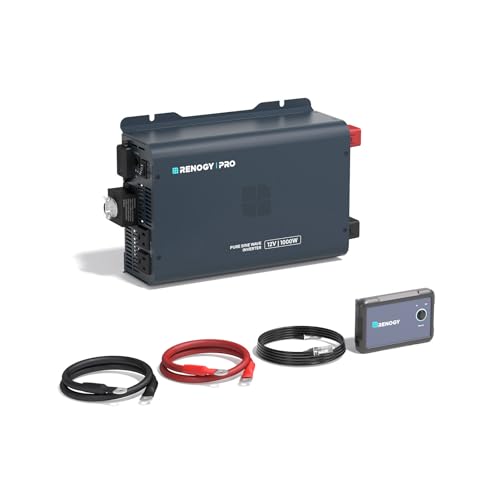
Renogy Pro 1000W Pure Sine Wave Inverter 12V to 120V
One thousand watts covers a laptop, a blender, a drill charger and a small induction burner on its lowest setting. Pure sine wave matters: modified sine damages some chargers and makes motors run hot.
Best for: Laptops, tools and light kitchen use
Check price
Giandel 2000W Pure Sine Wave Inverter 12V to 120V
Two thousand watts at an entry price, with a hardwire block and a USB-C PD port. The efficiency and idle draw are not in the Victron class, so switch it off when nothing is plugged in.
Best for: Occasional high-wattage use on a budget
Check price
Renogy Pro 2000W Pure Sine Wave Inverter 12V to 120V
Ninety-two percent efficiency at 2000W, which is the difference between a full induction burner working and browning out. Remember this pulls roughly 180A from the battery at full output.
Best for: Induction cooking and full-size power tools
Check price
Victron Energy Phoenix 1200VA 12V Pure Sine Wave Inverter
Costs more than a 2000W budget unit and delivers less peak power, and is still the better buy for many builds because of its very low idle draw and its ability to be left on permanently.
Best for: Always-on inverters in a full-time build
Check price
Victron Energy MultiPlus-II 3000VA 12V Inverter Charger
Inverter, shore power charger and automatic transfer switch in one box, which removes three separate components and their wiring. At 12V it will pull well over 250A at full load, so cable and fusing must be sized properly.
Best for: Full-time builds with shore power hookups
Check priceVictron Energy Phoenix Inverter Smart 12/2000
The larger Phoenix with built-in Bluetooth. Amazon stock on this specific variant comes and goes, so this opens a scoped search rather than pointing at a listing that may be gone.
Best for: Victron systems needing 2000VA without a charger
Find on AmazonPrices change often, confirm on Amazon. Products without a direct listing sell mainly through dealers, so those links open a scoped Amazon search. As an Amazon Associate we earn from qualifying purchases.
What else decides whether an inverter works properly?
Cable, before anything else. An inverter that browns out under load is usually not a faulty inverter, it is a starved one. DC amps equal AC watts divided by 12 times efficiency, so 2000W at 90 percent is roughly 185A, and at 10 ft that needs 2/0 cable to stay inside a 0.36V drop. In 2 AWG the same run drops 0.577V, the inverter sees under 11.5V at its terminals at full load, and it may shut down on low voltage while the battery is still half full. Mounting the inverter beside the battery rather than across the vehicle is the cheapest fix available.
Terminations next. A poorly crimped lug on a 185A cable has resistance, and resistance at that current is a heater that will eventually melt insulation and find something to short against. A 10 ton hydraulic lug crimper at $46.99 is the cheapest genuine safety item in the build, and tinned lugs sealed with adhesive-lined heat shrink keep water out of the strands, which is how a good crimp turns green and then hot.
Fusing last and most importantly. The fuse goes within a few inches of the battery positive post, above the working current and at or below the ampacity of the cable, which for a 2000W inverter on 2/0 means a 250A class T. A Blue Sea Systems 5191 MRBF Terminal Fuse Block (30 to 300A) bolts straight to the post for smaller circuits, and a RED WOLF 4 Way ANL Fuse Holder and Distribution Block (12V) gives four fused outputs from the battery. The full method, with the worked 2000W example, is in the 12V wiring and fusing guide.
How can you tell what an inverter really produces?
Not from the marketing, which is where a lot of people get caught. Some listings describe a modified sine unit with phrases that sound like a quality claim without ever using the words pure sine, and a few use terms that imply a smoother waveform than a three-level stepped output actually is. If a listing does not say pure sine wave plainly, assume it is not one.
The most reliable indicator on a specification sheet is total harmonic distortion. A genuine pure sine inverter states a figure, usually under 3 percent and often under 5 percent, because the manufacturer is proud of it. A modified sine unit almost never quotes one, because the number would be somewhere around 25 to 40 percent. A missing harmonic distortion figure is not proof of anything on its own, but combined with vague waveform language it is a strong signal.
There is a cheap physical test as well. Plug in a small mains-powered transformer or an inexpensive AC fan and listen. On modified sine, laminated transformer cores buzz audibly at the harmonics and small motors emit a rough growl instead of a smooth hum. It is not a laboratory measurement, but it is unmistakable once you have heard both, and it costs nothing.
One more thing worth checking before purchase, regardless of waveform: whether the unit has a hardwire terminal block rather than only socket outlets. In a vehicle, an inverter feeding a fixed circuit through a hardwire block is a tidier and safer installation than one with an extension lead hanging off the front, and it makes the AC side something you can loom, secure and protect properly rather than something that gets pulled out from behind a panel every time it is used.
Where to go next
- The inverter installation guide, for mounting, cable and the transfer switch question.
- The inverter roundup, with picks by build size.
- The inverter sizing calculator, to settle the wattage before the waveform.
- The appliance power draw chart, for what your load list actually pulls.
- 12V versus 24V, if the answer came out above 2000W.
- Victron MultiPlus-II 3000VA 12V review, the single-product review.
Frequently asked questions
What is the actual difference between the two waveforms?
Pure sine is a smooth sinusoid, the same shape a grid or a generator produces. Modified sine is a stepped approximation: it switches between a positive level, zero and a negative level, with dead time between steps so the RMS voltage comes out right. The average is correct and the shape is not, and everything that goes wrong on modified sine comes from the harmonics in those hard-edged steps.
What actually breaks on a modified sine inverter?
Induction motors run hot and noisy because harmonic content produces heat instead of torque, and they draw 10 to 20 percent more current for the same work. Some laptop and tool chargers refuse the waveform outright and others quietly degrade. Microwaves cook more slowly for the same power draw. Audio equipment picks up an audible buzz. Anything with phase-angle speed control behaves erratically.
Can I run a CPAP machine on modified sine?
No. Manufacturers of CPAP machines and other medical devices specify pure sine, and there is no upside to disregarding that. The failure is not always immediate or obvious, which is precisely the problem with a device you rely on overnight in a remote place. If a medical device is on your load list, that decides the inverter question on its own and there is nothing further to weigh.
Is modified sine more efficient?
The inverter itself can be marginally more efficient because the circuit is simpler, but the system is not. A motor on modified sine draws 10 to 20 percent more current for the same mechanical work and turns the difference into heat, so any efficiency gained in the box is lost again in the appliance. On resistive loads the two are equivalent, and resistive loads are a small part of what people actually run.
How much does the inverter cost me when nothing is plugged in?
More than most people expect. An inverter left on with nothing connected typically draws 15 to 25 watts, which is 360 to 600 watt-hours a day, or 28 to 47 amp-hours at 12.8V. That is most of a fridge day disappearing into nothing. Switch the inverter off when it is not in use, or choose a unit with genuinely low idle draw if it has to stay on permanently.
Is there any case left for modified sine in 2026?
A narrow one. If your entire AC load list is resistive, meaning a kettle, a heating element or an incandescent lamp, and the price gap is what decides whether you buy an inverter at all, modified sine will do that job correctly. The gap has narrowed to a few tens of dollars at 2000W, so for nearly everyone the honest answer is to buy pure sine and stop thinking about it.
Electrical safety: 12V is low voltage but not low energy. A lithium house battery can push several hundred amps into a short circuit, and undersized or unfused cable is one of the most common causes of vehicle fires in DIY builds. Every circuit must be fused at the source of power, within a few inches of the battery terminal, at or below the ampacity of the smallest conductor it protects. Size cable for voltage drop as well as ampacity, torque terminals to specification, and have a lithium installation inspected by a qualified installer before it carries load. The figures on this page are researched guidance, not a substitute for ABYC E-11 or your component manufacturer's installation manual.
How we choose: we compare published manufacturer specifications, standards documents including ABYC E-11, and verified owner reviews. We do not test gear in person. Vehicle payload, roof load and charging limits vary by model and year, so confirm yours against the door jamb sticker and the owner's manual rather than any number published here.
Totalling your own build weight against your payload? The Overland Build & Power Planner is the paid version of these pages: 8 printable worksheets you fill in with your own numbers, plus the full PDF, $29.