Best Power Inverter for a Van or Overland Build
The Renogy Pro 2000W pure sine wave inverter at $283.68 is the best pick for most van builds. At 92 percent efficiency a 2000W load pulls roughly 185 amps from a 12V battery, which needs 2 AWG cable as an absolute minimum and a fuse at or below the 210A ampacity of that conductor.
An inverter is the component that converts a 12V system into a wall outlet, and it is also the component most likely to be sized by wishful thinking. For most builds the answer is the Renogy Pro 2000W pure sine wave inverter at $283.68, because 2000W covers an induction burner and a full-size power tool, and because 92 percent efficiency is the difference between that burner running properly and the whole system browning out.
A pure sine wave inverter converts 12V DC into a clean 120V alternating current waveform that matches what a wall outlet produces. A modified sine wave unit produces a stepped square approximation instead, which most simple resistive loads tolerate and most motors, compressors and switching power supplies do not.
Best 12V inverters by build stage
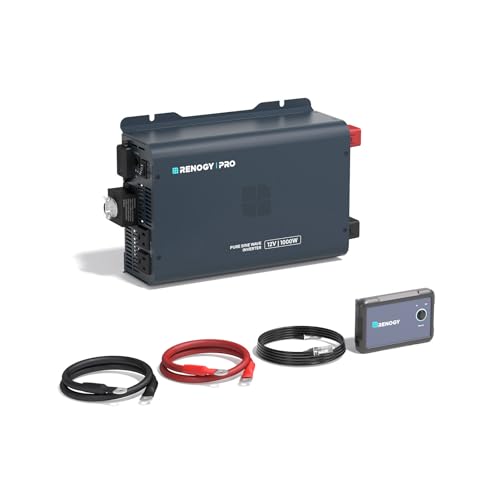
Renogy Pro 1000W Pure Sine Wave Inverter 12V to 120V
One thousand watts covers a laptop, a blender, a drill charger and a small induction burner on its lowest setting. Pure sine wave matters: modified sine damages some chargers and makes motors run hot.
Best for: Laptops, tools and light kitchen use
Check price
Giandel 2000W Pure Sine Wave Inverter 12V to 120V
Two thousand watts at an entry price, with a hardwire block and a USB-C PD port. The efficiency and idle draw are not in the Victron class, so switch it off when nothing is plugged in.
Best for: Occasional high-wattage use on a budget
Check price
Renogy Pro 2000W Pure Sine Wave Inverter 12V to 120V
Ninety-two percent efficiency at 2000W, which is the difference between a full induction burner working and browning out. Remember this pulls roughly 180A from the battery at full output.
Best for: Induction cooking and full-size power tools
Check price
Victron Energy Phoenix 1200VA 12V Pure Sine Wave Inverter
Costs more than a 2000W budget unit and delivers less peak power, and is still the better buy for many builds because of its very low idle draw and its ability to be left on permanently.
Best for: Always-on inverters in a full-time build
Check price
Victron Energy MultiPlus-II 3000VA 12V Inverter Charger
Inverter, shore power charger and automatic transfer switch in one box, which removes three separate components and their wiring. At 12V it will pull well over 250A at full load, so cable and fusing must be sized properly.
Best for: Full-time builds with shore power hookups
Check priceVictron Energy Phoenix Inverter Smart 12/2000
The larger Phoenix with built-in Bluetooth. Amazon stock on this specific variant comes and goes, so this opens a scoped search rather than pointing at a listing that may be gone.
Best for: Victron systems needing 2000VA without a charger
Find on AmazonPrices change often, confirm on Amazon. Products without a direct listing sell mainly through dealers, so those links open a scoped Amazon search. As an Amazon Associate we earn from qualifying purchases.
How much current does an inverter actually pull?
This is the number that governs every other decision, and it is arithmetic: DC amps equals AC watts divided by 12 multiplied by efficiency. A 2000W load at 90 percent efficiency pulls roughly 185A from a 12V battery. A 1000W load pulls about 93A. A 2400W continuous load pulls about 222A.
Two consequences follow immediately. The first is cable: 185A requires a conductor rated at least 185A, which under ABYC E-11 for copper with 105C insulation outside engine spaces means 2 AWG at 210A, with nothing smaller acceptable at any run length. The second is the battery itself. A 100Ah lithium battery with a 100A battery management system physically cannot deliver 185A, so the BMS will disconnect under load and the inverter will report a fault that is not its own. Check the continuous discharge rating of the pack before you size the inverter.
The third consequence is runtime, and it is sobering. A 2000W load drawing 185A empties the 85 usable amp-hours of a 100Ah lithium battery in about 27 minutes. Inverters do not run continuously in a van build; they run in bursts, and the correct mental model is energy per task, not watts. Boiling water for coffee is perhaps 60 watt-hours. Running a hair dryer for ten minutes is 250. Work the real numbers in the inverter sizing calculator and check appliance figures against the appliance power draw chart.
| Inverter | Continuous | DC amps at 90% | Min cable | Typical fuse | Price |
|---|---|---|---|---|---|
| Renogy Pro 1000W | 1,000W | 93A | 4 AWG | 125A | $188.69 |
| Giandel 2000W | 2,000W | 185A | 2 AWG | 200A | $179.99 |
| Renogy Pro 2000W | 2,000W | 185A | 2 AWG | 200A | $283.68 |
| Victron Phoenix 1200VA | 1,000W | 93A | 4 AWG | 125A | see listing |
| Victron Phoenix Smart 12/2000 | 1,600W | 148A | 2 AWG | 175A | sold via dealers |
| Victron MultiPlus-II 3000VA | 2,400W | 222A | 2/0 AWG | 300A | $1,005.47 |
DC amps are calculated as AC watts divided by 12 multiplied by 0.9. Minimum cable is the smallest copper conductor whose ABYC E-11 ampacity outside engine spaces exceeds the continuous DC current: 4 AWG is 160A, 2 AWG is 210A and 2/0 AWG is 330A. Fuses are sized above continuous draw and at or below conductor ampacity. Units rated in VA are shown at their approximate continuous watt output, since VA and watts are not the same figure. Many builders step one size up in cable to allow for surge and long runs, which is always acceptable and never wrong.
Which inverter should most van builds buy?
The Renogy Pro 2000W at $283.68. Two thousand watts is the size that stops you rationing: an induction burner on a real setting, a corded drill, a full-size blender, a compressor. Its 92 percent efficiency at full output is the specific spec that matters, because efficiency losses at this current level are heat, and heat in a sealed cabinet is what makes cheap inverters shut down mid-task.
The Giandel 2000W at $179.99 does the same job for $104 less, with a hardwire block and a USB-C PD port. The trade is efficiency and idle draw, neither of which is in the Victron class, so this is an inverter to switch off when nothing is plugged in. If your use pattern is genuinely occasional, that is a fine trade and the cheapest route to 2000W on this page.
The Renogy Pro 1000W at $188.69 is the right size for a build whose AC loads are a laptop, camera batteries, a drill charger and a small induction burner on its lowest setting. At 93A it also asks far less of the battery and the cable, which makes the whole install cheaper: 4 AWG instead of 2 AWG, and a 125A fuse instead of a 200A one. Do not buy inverter capacity you have no cable budget for.
Why does idle draw matter more than peak watts?
Because peak watts are used for minutes and idle draw runs for hours. An inverter switched on with nothing plugged in still powers its own control electronics, its cooling fan logic and its output stage, and on a budget 2000W unit that can be 15 to 25 watts continuously.
Twenty watts for 24 hours is 480 watt-hours, which is 37 amp-hours at 12.8V, which is most of a fridge day pulled out of your bank for nothing. Over a week that is a full 100Ah battery discharged by an appliance that produced no output at all. This is the single most common invisible drain in a 12V build, and it is why a clamp meter is worth owning.
The Victron Phoenix 1200VA exists precisely for this. It costs more than a 2000W budget unit and delivers less peak power, and it is still the better buy for many full-time builds, because its idle consumption is low enough that it can simply be left on. An inverter you never have to think about is worth more than one with a bigger number on the case, particularly if it feeds a permanently connected load.
How do you wire an inverter without creating a hazard?
Keep the DC side short and the AC side long. Current on the DC side is roughly ten times the AC current for the same power, so every foot of DC cable costs ten times as much in copper and voltage drop as a foot of AC cable. Mount the inverter as close to the battery as ventilation allows and run the 120V output to wherever the outlets need to be.
Fuse the positive feed within a few inches of the battery terminal, sized above continuous draw and at or below the ampacity of the conductor. For a 2000W inverter on 2 AWG, that is a 200A fuse against a 210A conductor rating. Builders who want surge headroom step the cable to 1/0 AWG at 285A and fit a 250A fuse, which is a perfectly good decision and costs about thirty dollars more. Cross check any combination against the fuse sizing chart.
Crimp the lugs properly. You cannot hand-crimp a 2 AWG lug, and a bad crimp on a 185A cable is not a poor connection, it is a heater. A 10 ton hydraulic lug crimper at $46.99 is the cheapest safety item in the entire build. Protect every cable that crosses a metal edge with split wire loom at $21.99 and a grommet at each pass-through. Confirm your own run lengths with the wire gauge calculator and follow the sequence in the inverter installation guide.
Who should not buy the expert tier?
Do not buy the Victron MultiPlus-II 3000VA at $1,005.47 unless you have shore power hookups and a bank that can feed it. It is an inverter, a shore power charger and an automatic transfer switch in one box, which genuinely removes three components and their wiring, and at 12V it will pull well over 250A at full load. That demands 2/0 cable, a 300A class fuse and a battery bank with the discharge headroom to supply it, none of which is a weekend upgrade. In a build with no shore power, two thirds of what you paid for sits unused.
Do not buy the Victron Phoenix Inverter Smart 12/2000 over the Renogy Pro 2000W on output alone, because it delivers less continuous power for more money. Buy it if you are already running VictronConnect across a charge controller and a shunt and want one app that shows the whole system. Amazon stock on this specific variant comes and goes, so that link opens a scoped search rather than pointing at a listing that may be gone.
And do not buy any inverter above 1000W if your battery bank is a single 100Ah pack. The BMS current limit, not the inverter, is what will stop you, and a 2000W inverter on a 100A BMS is a fault waiting to happen in the middle of cooking. Fix the storage side first, then the conversion side. If your only AC loads are laptops and phones, consider a 12V USB-C Power Delivery socket at $21.21 instead and skip the inverter entirely: the DC to AC to DC round trip you avoid is roughly 15 percent of the energy every single time.
What do people get wrong when buying an inverter?
- Reading surge watts as continuous watts. A brief surge rating is for motor startup, not for a ten minute kettle.
- Sizing cable to the inverter's fuse instead of its current. The current is the physical fact; the fuse just has to sit above it and below the cable rating.
- Ignoring the battery discharge limit. A 100A BMS caps you near 1000W of AC output no matter what the inverter says.
- Leaving it powered with nothing plugged in. Idle draw is invisible and it is the biggest quiet loss in most builds.
- Mounting it inside a sealed box. Inverter efficiency losses become heat, and heat with nowhere to go becomes a shutdown or a failure.
- Treating the AC side casually. The output is real mains voltage in a metal vehicle, so it needs correct gauge, correct enclosures and residual current protection.
If you are still weighing the waveform question at the budget end, the pure sine versus modified sine comparison sets out exactly which loads care and which do not. The short version is that the price gap no longer justifies the risk, and every unit on this page is pure sine for that reason.
Frequently asked questions
How many amps does a 2000W inverter draw from a 12V battery?
Roughly 185 amps at full output. The arithmetic is DC amps equals AC watts divided by 12 multiplied by efficiency, so 2000 divided by 12 times 0.9 gives 185A. That is the number that decides cable size, fuse size and whether your battery management system can even supply the load. A 100Ah battery with a 100A BMS cannot run a 2000W inverter at full output at all.
Do I need a pure sine wave inverter?
Yes, for anything with a motor, a compressor, a switching power supply or a microprocessor. Modified sine wave is a stepped approximation of AC, and it makes motors run hot, causes audible buzz in audio gear, and damages some laptop and tool chargers over time. Every inverter on this page is pure sine wave, because the price gap has narrowed to the point where modified sine is no longer worth the risk.
What size inverter do I need for a van?
Size to the largest single load you will actually run, not the total of everything you own. A laptop, camera chargers and a blender fit inside 1000W. A full induction burner, a hair dryer or a corded power tool needs 2000W. Above that you are into air conditioning and full kitchen appliances, which is a 3000W and 300 amp-hour conversation rather than a weekend build one.
Should I leave the inverter switched on all the time?
Only if it has genuinely low idle draw. A budget 2000W unit can consume 15 to 25 watts doing nothing at all, which is 360 to 600 watt-hours a day, or roughly half a small battery bank burned for no output. Premium units idle far lower and are designed to be left on. If yours is not one of those, wire a switch and use it.
Can I charge a laptop without an inverter?
Yes, and you should where possible. A 12V USB-C Power Delivery socket at 65W charges most laptops directly from the battery, skipping the DC to AC to DC round trip that costs roughly 15 percent of the energy every single time. An inverter earns its place for the loads that genuinely require mains AC, not for the ones that only require a familiar plug.
Where should the inverter be mounted?
As close to the battery as the cable run allows, in a ventilated space, with the DC cables kept short and the AC output run long instead. High current on a long DC cable is expensive in both copper and voltage drop, while AC wiring carries a fraction of the current for the same power. Never mount an inverter inside a sealed battery box or against a surface that blocks its cooling fan.
Electrical safety: 12V is low voltage but not low energy. A lithium house battery can push several hundred amps into a short circuit, and undersized or unfused cable is one of the most common causes of vehicle fires in DIY builds. Every circuit must be fused at the source of power, within a few inches of the battery terminal, at or below the ampacity of the smallest conductor it protects. Size cable for voltage drop as well as ampacity, torque terminals to specification, and have a lithium installation inspected by a qualified installer before it carries load. The figures on this page are researched guidance, not a substitute for ABYC E-11 or your component manufacturer's installation manual.
How we choose: we compare published manufacturer specifications, standards documents including ABYC E-11, and verified owner reviews. We do not test gear in person. Vehicle payload, roof load and charging limits vary by model and year, so confirm yours against the door jamb sticker and the owner's manual rather than any number published here.
Totalling your own build weight against your payload? The Overland Build & Power Planner is the paid version of these pages: 8 printable worksheets you fill in with your own numbers, plus the full PDF, $29.