Best 12V Lights for Overlanding and Van Builds
The RIGID D-Series PRO flood pods at $185 a pair are the best 12V auxiliary lights for most overland builds, because two well aimed pods beat a cheap 50 inch bar in almost every real situation. For camp lighting, a 20 ft 12V LED strip draws roughly 2 amps and gets a 5 amp fuse, and a full evening of camp and awning light costs about 10 to 11 amp-hours.
Lighting is the cheapest upgrade in a 12V build that genuinely changes how a vehicle feels to live in, and it is also the category where the most money gets wasted on the wrong thing. For auxiliary driving light the answer for most builds is the RIGID D-Series PRO flood pods at $185.00 a pair, because two well aimed pods beat a cheap 50 inch bar in almost every real situation, and because RIGID optics survive the vibration and thermal cycling that kills bargain housings on corrugated dirt.
A 12V light is any fixture wired to run directly from a nominal 12 volt DC vehicle circuit, as opposed to a self-contained rechargeable lantern or an AC fixture behind an inverter. That distinction matters more than any spec on a box, because it decides whether the light needs a fuse, a switch, a wire run and a hole in something, or whether it just needs charging before you leave.
Best 12V lights by build stage

Glocusent LED Camping Lantern (1500 lm, Rechargeable)
A rechargeable lantern draws nothing from the house battery, which makes it the cheapest lighting decision in the build. Warm colour temperature matters more than lumens after dark.
Best for: Camp lighting with zero wiring
Check price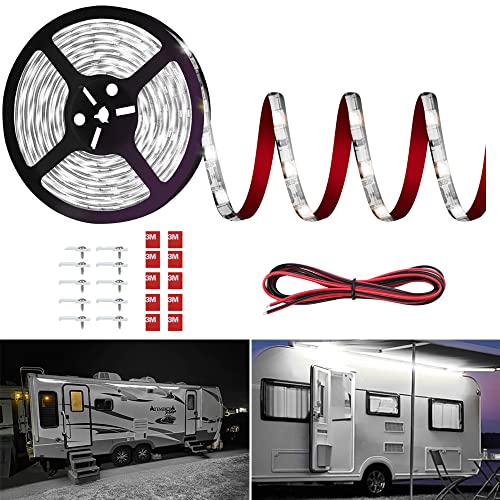
Vbakor 12V RV Awning LED Light Strip (20 ft, White)
Twenty feet of 12V strip draws roughly 2A and lights an entire awning area. Wire it through a switch and a 5A fuse rather than straight to the battery, and use warm white to keep bugs down.
Best for: Lighting under an awning on a fixed circuit
Check price
Goal Zero Lighthouse 600 Lantern and USB Power Hub
Charges phones as well as lighting a camp, and has a hand crank for the situation where nothing else has charge. One of the few Goal Zero products with a consistent Amazon listing.
Best for: Lighting that doubles as a backup power source
Check price
Firehawk 30 in LED Light Bar (Spot Flood Combo, IP68)
Auxiliary driving light at an entry price, supplied with a wiring harness and relay. A light bar is for off-highway use only in most jurisdictions, so wire it through a switch you cannot hit by accident.
Best for: Slow off-highway night driving on a budget
Check price
RIGID D-Series PRO LED Light Pods, Flood (Pair)
Small pods with a genuinely useful beam pattern and optics that hold up to vibration and thermal cycling. Two well aimed pods beat a cheap 50 inch bar in almost every real situation.
Best for: Ditch lights and rock lights that will last
Check price
Baja Designs Squadron 2.0 Pro LED Light Pods, Driving Combo, Amber (Pair)
Amber output cuts through dust and fog where white light reflects straight back at you, which is the specific problem on a dirt road behind another vehicle. Priced accordingly.
Best for: Dust and fog, where beam quality actually decides visibility
Check pricePrices change often, confirm on Amazon. Products without a direct listing sell mainly through dealers, so those links open a scoped Amazon search. As an Amazon Associate we earn from qualifying purchases.
What are the three different lighting jobs on a vehicle?
The whole category gets confused because three genuinely different purchases share one word. Conflating them is why people end up with a 50 inch light bar and still cannot see their own cooking. Buy them as three separate decisions, in this order.
Camp and interior lighting comes first, and it is the one that changes daily life. This is warm colour temperature, low output, low draw: a rechargeable lantern on the table, a pair of puck lights over the galley, a strip inside a canopy. Nothing here needs to be bright. Warm white at low output preserves night vision, keeps a small space from feeling like a workshop, and attracts noticeably fewer insects than cool white. The Glocusent LED Camping Lantern at $24.99 is the cheapest lighting decision in any build precisely because it draws nothing at all from the house battery. It has its own cell, you charge it off a USB socket, and it never appears in your amp-hour budget.
Area lighting under an awning comes second, and this is where 12V wiring starts. An awning turns a patch of dirt into an outdoor room, and an unlit outdoor room stops being useful at dusk. The right tool is a long strip washing the underside of the awning fabric, not a point source glaring into everyone's eyes. Twenty feet of Vbakor 12V RV awning strip at $25.99 draws roughly 2 amps and lights the entire footprint of a 270 degree awning. This circuit is a real circuit: a switch you can reach, a 5 amp fuse in a fuse block, wire routed and secured. A flood pod aimed down and outward from the rack complements the strip for tasks like cooking or changing a tyre, on its own switched and fused feed.
Auxiliary driving light comes last, and it is the only one that is genuinely optional. Bars and pods exist to extend vision on unlit off-highway tracks at low speed. In most jurisdictions they are off-highway equipment only, which means covered or switched off on public roads. They draw an order of magnitude more current than camp lighting, they need a relay, and they need aiming, which almost nobody does. A pod aimed a degree too high lights the treetops and blinds oncoming drivers. A pod aimed correctly lights the road surface 30 to 60 feet ahead of the headlight cutoff, which is exactly where you need it at 15 mph on rock.
How do the six picks actually compare?
Three of these are self-powered or low draw camp lighting and three are wired accessories. The prices are the current listed figures and they move, so confirm before ordering.
| Light | Job | Power source | Draw at 12V | Beam and colour | Price |
|---|---|---|---|---|---|
| Glocusent LED Lantern | Camp and interior | Internal battery, USB recharge | 0A from house bank | Wide, warm and cool modes | $24.99 |
| Vbakor 20 ft 12V strip | Awning and area | Fused 12V circuit | 2.0A | Wide wash, white | $25.99 |
| Goal Zero Lighthouse 600 | Camp, plus USB hub | Internal battery, USB, hand crank | 0A from house bank | 360 degree, dimmable | $79.95 |
| Firehawk 30 in light bar | Auxiliary driving | Relay and harness, engine running | 10 to 15A | Spot and flood combo, white | $99.99 |
| RIGID D-Series PRO, pair | Ditch, rock and work light | Relay and switched feed | roughly 4A | Flood, white | $185.00 |
| Baja Designs Squadron 2.0 Pro, amber pair | Auxiliary driving in dust | Relay and switched feed | roughly 7A | Driving combo, amber | $479.95 |
Draw figures are researched typical values for the class of fixture rather than a single published number, because manufacturers quote wattage at different voltages and LED current varies with temperature. Divide rated watts by 12 for a conservative amp figure and by 13.8 if you want the number while the alternator is charging. Verify against a clamp meter on your own install: a digital clamp meter at $35.99 settles the argument in ten seconds and finds the parasitic draw you did not know about.
What colour temperature and beam pattern should you choose?
Colour temperature and beam pattern decide satisfaction far more than lumens do, and both are printed in smaller type than the lumen figure on every box in the category.
Warm white, roughly 2700K to 3500K, belongs at camp. It reads as firelight rather than a parking lot, it lets your eyes stay partly dark-adapted so you can still see past the table, and it pulls in visibly fewer insects than cool white because flying insects are drawn strongly to the short-wavelength end. If you buy one thing from this section, buy warm strips for the awning and interior rather than the daylight-white strips that dominate listings.
Amber, roughly 2200K to 3000K in a driving light, belongs anywhere there is something in the air. White light hits dust, fog and falling snow and scatters straight back at the driver as a luminous wall, which is worse than having no auxiliary light at all. This is the specific misery of following another vehicle on a dirt road. Amber scatters less and lets you see the track edge. The Baja Designs Squadron 2.0 Pro amber pair at $479.95 exists for exactly that condition and is priced accordingly.
Beam pattern splits three ways. A spot is a narrow high intensity beam for distance, useful only at speeds where you need to see far, which on an overland track you rarely do. A flood is a wide short throw, which is what lights the ground beside the vehicle, the recovery point you are digging out, and the awning area. A combo puts both optics in one housing, which is the honest compromise and why the Firehawk 30 in bar at $99.99 ships that way. For a first auxiliary purchase, flood beats spot: the problem on a slow rocky track is seeing the edges, not seeing a quarter mile ahead.
How many amp-hours does 12V lighting use in an evening?
This is the number that should stop anyone worrying about lighting load. Camp and area lighting is trivial next to a fridge. Auxiliary driving lights are large loads, but they run with the engine on, so the alternator carries them and they barely touch the house bank.
| Fixture | Typical current | Hours of use | Ah per evening | Notes |
|---|---|---|---|---|
| Rechargeable lantern | 0A | 4 | 0 | Self-powered, recharge off a USB socket |
| 20 ft 12V awning strip | 2.0A | 3 | 6.0 | Switched, 5A fuse, 16 AWG |
| Interior puck lights, pair | 0.5A | 4 | 2.0 | Warm white, dimmed |
| Awning flood pod, one | 2.5A | 1 | 2.5 | Task light for cooking and repairs |
| Camp subtotal | n/a | n/a | 10.5 | What the house bank actually pays |
| 30 in light bar | 12A | 0.5 | 6.0 | Engine running, alternator supplies it |
| Compact pods, pair | 4A | 0.5 | 2.0 | Engine running, alternator supplies it |
| Total including driving lights | n/a | n/a | 18.5 | Only if you drive at night off the alternator |
10.5 amp-hours is roughly a tenth of one 100Ah LiFePO4 battery, which is usable to 80 to 90 percent depth of discharge and so delivers 80 to 90Ah. Put differently, a whole week of camp lighting costs less than two days of a 45 quart fridge, which runs 30 to 45 amp-hours a day at 90F ambient. Feed your own fixture list into the power consumption calculator to get a daily total, then size storage against it with the battery bank calculator. Lighting will not be the line that decides your battery. It is the line that makes the battery worth having.
How do you wire and fuse 12V lighting correctly?
There are two distinct wiring problems here, and treating them the same way is how people burn switches and melt harnesses.
Small loads go straight to a fuse block. A 20 ft LED strip at roughly 2 amps gets its own blade fuse in a 12 way blade fuse block at $16.98, fed with 16 AWG wire and a switch you can find in the dark. Fuse it at 5 amps. The fuse protects the wire, never the light, so the ceiling is the conductor ampacity and the floor is the continuous load. You want the smallest standard fuse comfortably above the load, because a 25 amp fuse on a 2 amp circuit will happily let a chafed 16 AWG wire glow for a while before anything opens.
Auxiliary driving lights get a relay, a deliberate switch and a fuse at the source. A 30 inch bar at 10 to 15 amps, or a pair of large driving pods at 7 amps, is more current than a dash switch and its pigtail were built to carry. A relay solves it: a thin trigger wire from the switch energises a coil, and the coil closes a heavy contact on a short fused feed taken near the battery. The heavy current never enters the cabin. The switch must be one you cannot hit by accident, because auxiliary lights are off-highway equipment in most jurisdictions and an accidental flick on a public road blinds oncoming traffic.
Every one of these feeds is fused at the source of power, within a few inches of the battery terminal, at or below the ampacity of the smallest conductor it protects. On a battery post that means an MRBF terminal fuse block at $9.99, which is ten dollars and the single most important part in a lighting install. Where a cable crosses a metal edge on its way forward, it gets split wire loom at $21.99 and a grommet, because vibration will find the one pass-through you skipped.
| Lighting circuit | Load | Wire | Ampacity | Fuse | Relay? |
|---|---|---|---|---|---|
| Interior puck lights | 0.5A | 16 AWG | 25A | 5A | No |
| 20 ft awning LED strip | 2A | 16 AWG | 25A | 5A | No |
| Awning flood pods, pair | 5A | 14 AWG | 35A | 10A | Optional |
| Compact driving pods, pair | 4 to 7A | 14 AWG | 35A | 10A | Yes |
| 30 in light bar | 10 to 15A | 12 AWG | 45A | 20A | Yes |
| Relay trigger from dash switch | under 1A | 18 AWG | 20A | 5A | n/a |
Ampacity figures are ABYC E-11 for copper with 105C insulation, outside engine spaces, with three or fewer conductors in a bundle: 16 AWG is 25A, 14 AWG is 35A and 12 AWG is 45A. Inside an engine space the same conductor derates by roughly 30 percent, which matters because the forward run to a bumper-mounted bar usually passes through exactly that heat. The full table is on the wire gauge ampacity chart, and the fuse logic is set out in detail on the fuse sizing chart. If you want the whole method rather than a lookup, read the 12V wiring and fusing guide.
How much voltage drop can a lighting run take?
Voltage drop is the voltage lost in the wire itself before it reaches the light, and it is proportional to current, run length and the wire's resistance. The formula is Vdrop = 2 x L x I x R, where L is the one-way run length in feet, I is current in amps and R is resistance in ohms per foot. The factor of 2 is there because the current has to go out and come back. Forgetting it is the single most common sizing error in DIY builds and it makes every result half of what it should be.
On a 12V system the 3 percent target is 0.36V. Critical circuits get 3 percent: panel feeds, the main DC trunk, anything with a motor. Non-critical lighting can take 10 percent, which on 12V is 1.2V, because an LED driver simply runs slightly dimmer rather than failing. That single allowance is why lighting is forgiving and why a fridge circuit is not.
Work a real example. A pair of driving pods drawing 12A combined, on an 18 ft one-way run from a battery in the rear to a front bumper, using 10 AWG copper at 0.000999 ohms per foot:
Vdrop = 2 x 18 x 12 x 0.000999 = 0.43V, which is 3.6 percent of 12V. That fails the 3 percent target and passes the 10 percent lighting allowance comfortably, so 10 AWG is a legitimate choice here. Step up to 8 AWG at 0.000628 ohms per foot and Vdrop = 2 x 18 x 12 x 0.000628 = 0.27V, or 2.3 percent, which clears the 3 percent target with room to spare. One gauge is a few dollars, so if the run is already going in, size it for 3 percent.
Now the strip, to show the other end of the scale. Twenty feet of strip at 2A on a 14 ft one-way run in 10 AWG: Vdrop = 2 x 14 x 2 x 0.000999 = 0.06V, half of one percent. Low-current lighting is never limited by voltage drop. It is limited by ampacity, by mechanical protection and by whether the conductor is fine-stranded enough to survive vibration, which is why 16 AWG marine grade wire is the right call for a strip and 22 AWG bell wire is not.
| One-way run | 10 AWG drop at 12A | Percent | 8 AWG drop at 12A | Percent |
|---|---|---|---|---|
| 5 ft | 0.12V | 1.0% | 0.08V | 0.6% |
| 10 ft | 0.24V | 2.0% | 0.15V | 1.3% |
| 15 ft | 0.36V | 3.0% | 0.23V | 1.9% |
| 20 ft | 0.48V | 4.0% | 0.30V | 2.5% |
| 30 ft | 0.72V | 6.0% | 0.45V | 3.8% |
Read that table as a decision, not a curiosity: 10 AWG hits the 3 percent target at exactly 15 feet one-way at 12 amps, and every foot past that is borrowed against the 10 percent lighting allowance. Run your own current and length through the wire gauge calculator, and use the voltage drop by run length chart when you want to compare several gauges at once.
Do IP ratings and vibration resistance actually matter?
An IP rating is a two digit code for sealing: the first digit is solids, the second is water. IP67 means dust tight and able to survive temporary immersion. IP68 means dust tight and rated for continuous immersion at a stated depth. Anything exterior on a vehicle should be IP67 at minimum, and the Firehawk bar is rated IP68, which is genuinely good for a $99.99 fixture.
Sealing, though, is not what kills lights on an overland vehicle. Vibration and thermal cycling are. A light that survives a driveway and a car wash fails on corrugations because the failure modes are different: solder joints on the LED board crack, the reflector loosens in its housing, the potting compound separates from the lens, and the seal that was fine when new opens up after ten thousand heating and cooling cycles at 40 Hz. Corrugated washboard is a continuous high-frequency shake at exactly the frequencies that find resonances in a cheap die-cast housing.
This is the real argument for the expert tier. What $185 buys in the RIGID D-Series PRO over $99.99 of light bar is not lumens, it is a housing, a lens bond and a driver board engineered to survive that shake for years. Owner reports across the category are consistent on this point: the cheap fixtures work beautifully and then fill with water or go half-dark after a season of dirt roads, while the established brands keep going. Also check the mount. A bracket that vibrates is a bracket that changes your aim, and a pod that quietly walks two degrees upward over a season is a pod that now blinds people.
Which 12V lights should most people buy?
Start with the beginner tier and be honest that it is enough for a lot of people. The Glocusent lantern at $24.99 and the Vbakor 20 ft strip at $25.99 together cost about fifty dollars and cover camp, interior and awning lighting. That is the entire lighting budget for a first build, and it is the pairing on the beginner overland power setup for exactly that reason: the lantern needs no wiring at all, and the strip is the simplest possible 12V circuit to learn on.
The intermediate tier splits by job. The Goal Zero Lighthouse 600 at $79.95 is a camp light that doubles as a USB power hub with a hand crank, which is worth having when the house bank is down and a phone needs to make one call. The Firehawk 30 in bar at $99.99 is the cheap entrance to auxiliary driving light, supplied with a harness and relay so the install is a weekend job rather than a project. It is a real answer for slow off-highway night driving on a budget, with the durability caveat above.
The expert tier is where beam quality and survival get bought. The RIGID D-Series PRO flood pair at $185.00 is the pick for most builds that have got as far as wanting real auxiliary light, because the pods are small enough to mount as ditch lights, rock lights or reverse lights, and the optics do more with 4 amps than a bargain bar does with 12. The Baja Designs Squadron 2.0 Pro amber pair at $479.95 solves one specific problem better than anything else: seeing through dust and fog.
Who should not buy the expert tier?
Do not buy the Baja Designs Squadron 2.0 Pro amber pair at $479.95 as a first lighting purchase. Plainly: a $480 pair of pods is not a rational first buy on a vehicle that does not yet have a fused fuse block, a switch panel and camp lighting. It is roughly ten times the cost of the lantern and strip combination that will improve your trips ten times more. Buy it when you have specifically been miserable following another vehicle through dust at night, and not before.
Do not buy the RIGID D-Series PRO at $185.00 if your night driving is pavement and graded forest road with the headlights on. Auxiliary light earns its money at low speed on rough tracks and during recoveries. If that is not your driving, the money buys a better fridge, a bigger battery or a vehicle awning, all of which you will use every single trip.
And do not buy any auxiliary light before the mounting and the circuit exist. A pod needs a rated mounting point, a relay, a fused feed sized to the wire and a switch placed where you will not knock it. Buying the light first and improvising the install is how a $185 pair of pods ends up on a 20 amp fuse through a $4 rocker switch in a dash blank, which is a fire risk out of all proportion to the money saved.
What do people get wrong when buying 12V lights?
- Buying lumens. Colour temperature and beam pattern decide satisfaction. A 1500 lumen warm lantern beats a 20,000 lumen bar for everything you actually do at camp.
- Cool white everywhere. Daylight white strips make a small space feel clinical, wreck night vision and pull in insects. Warm white for camp, always.
- Skipping the relay. Ten to fifteen amps through a dash switch and its pigtail is how switches melt. The switch should carry a trigger signal, not the load.
- Fusing to the load instead of the wire. The fuse exists to protect the conductor. Ceiling is the wire's ampacity, floor is the continuous load, and you pick the smallest standard fuse comfortably above the load.
- Never aiming anything. An unaimed pod lights the treetops and blinds oncoming drivers. Park facing a wall at 25 feet and set the hot spot below the headlight cutoff.
- Ignoring vibration. A light rated IP68 can still fail on corrugations, because the failure mode is cracked solder and a loosened lens bond, not water.
- Forgetting the switch panel. Three lighting circuits means three switches and three fuses. Plan the panel before you run the first wire, or you will run it twice.
Lighting is the cheapest satisfying upgrade in a 12V build. Fifty dollars of lantern and strip changes every evening of every trip, and it costs about ten amp-hours to run. Auxiliary driving light is a separate, later, much more expensive decision that most builds can defer indefinitely. Get the camp and awning circuits right first, size their wire and fuses with the wire gauge calculator, and treat the pods as the reward rather than the starting point.
Frequently asked questions
How many amp-hours does 12V lighting use in an evening?
Far less than people fear. A 20 ft 12V LED strip draws roughly 2 amps, so three hours of awning light is about 6 amp-hours. Add a pair of interior puck lights at half an amp for four hours and one flood pod for an hour and a full evening of camp lighting lands near 10 to 11 amp-hours. That is a tenth of a 100Ah lithium battery, which is why lighting is the cheapest satisfying upgrade in a build.
What fuse does a 12V LED light strip need?
A 20 ft strip pulling about 2 amps runs happily on a 5 amp blade fuse in a fuse block, fed with 16 AWG wire. The fuse protects the wire, not the strip, so the ceiling is the conductor ampacity and the floor is the load. Sixteen gauge copper is rated 25 amps outside engine spaces, so anything from 5 to 25 amps protects the wire, and 5 amps is the size that will actually open on a fault.
Do LED light bars need a relay?
Yes, any auxiliary driving light does. A 30 inch bar can pull 10 to 15 amps and a pair of large driving pods 7 amps or more, which is too much current to route through a dash switch and its thin wiring. A relay lets a small trigger wire from the switch close a heavy contact near the battery, so the high current takes the short fused path and the switch only carries the signal.
Is amber or white better for auxiliary lights?
White throws further and renders detail better on clean, dry roads. Amber wins the moment there is dust, fog or falling snow in the air, because white light scatters off airborne particles and reflects back into your own eyes as a wall of glare. Amber cuts a lower colour temperature through that scatter. If you drive dirt roads behind other vehicles, amber is not a style choice.
Are light bars street legal?
In most jurisdictions auxiliary driving lights are for off-highway use only and must be covered or switched off on public roads. Rules vary by state and country, and enforcement varies more, so treat any light bar or pod as off-highway equipment by default. Wire it through a clearly marked switch you cannot hit by accident, and confirm the rules where you actually drive before you rely on them.
Should I buy a light bar or a pair of pods?
Pods, almost always. Two well aimed pods put usable light where you need it at a fraction of the current and a fraction of the frontal area of a bar, and the optics in a good pod are better than the optics in a cheap 50 inch bar. A bar makes sense when you want a wide even wash for slow desert driving. For ditch lights, rock lights and work light, pods win.
Electrical safety: 12V is low voltage but not low energy. A lithium house battery can push several hundred amps into a short circuit, and undersized or unfused cable is one of the most common causes of vehicle fires in DIY builds. Every circuit must be fused at the source of power, within a few inches of the battery terminal, at or below the ampacity of the smallest conductor it protects. Size cable for voltage drop as well as ampacity, torque terminals to specification, and have a lithium installation inspected by a qualified installer before it carries load. The figures on this page are researched guidance, not a substitute for ABYC E-11 or your component manufacturer's installation manual.
How we choose: we compare published manufacturer specifications, standards documents including ABYC E-11, and verified owner reviews. We do not test gear in person. Vehicle payload, roof load and charging limits vary by model and year, so confirm yours against the door jamb sticker and the owner's manual rather than any number published here.
Totalling your own build weight against your payload? The Overland Build & Power Planner is the paid version of these pages: 8 printable worksheets you fill in with your own numbers, plus the full PDF, $29.