Best DC-DC Charger for Van and Overland Builds
The Renogy Smart 50A DC-DC MPPT charger at $253.03 is the best pick for most van builds. Fifty amps is roughly 600 watts of charging, which refills the 80 usable amp-hours of a 100Ah LiFePO4 battery in about two hours of driving. At 50A over a 20 foot one-way run, use 2 AWG cable to stay inside the 0.36V voltage drop target.
A DC-DC charger is what turns driving into charging. Without one, a lithium house battery connected to a running engine stalls somewhere near 80 percent and stays there, because the alternator holds the system at a voltage LiFePO4 will not fully charge from. For most builds the right unit is the Renogy Smart 50A DC-DC MPPT charger at $253.03, because 50A is roughly 600 watts, and 600 watts turns a two hour drive between camps into a full battery.
A DC-DC charger is a voltage converter with a battery charging algorithm built into it. It takes whatever the alternator is producing, typically 13.2 to 14.8V and often varying under the vehicle's own control, and outputs a stable multi-stage charge profile matched to the chemistry of the house battery, while limiting the current it draws so the alternator is never asked for more than it can supply.
Best DC-DC chargers by build stage

Renogy REGO 12V 30A DC-DC Charger with MPPT (Dual Input)
Alternator and solar into one unit at the smallest sensible current for a single 100Ah battery. Dual input means one device, one set of fuses and one less thing to find space for.
Best for: A single 100Ah lithium battery with a modest roof array
Check price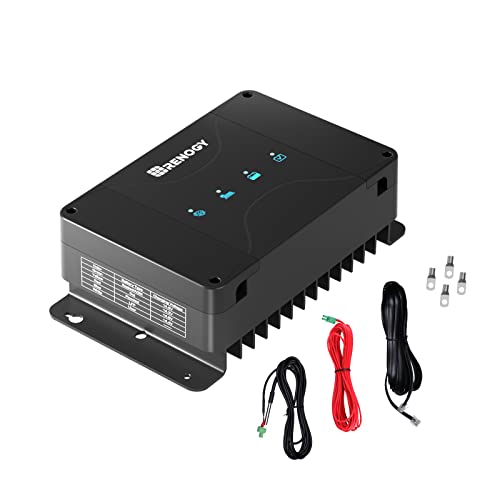
Renogy Smart 50A DC-DC MPPT Battery Charger 12V (Dual Input)
Fifty amps is roughly 600W of charging, which refills a 100Ah bank in about two hours of driving. This is the size most van builds settle on, and it is the one that makes drive time genuinely useful.
Best for: Most 100Ah to 200Ah builds
Check price Renogy REGO 12V 50A DC-DC Charger with MPPT (Dual Input)
The REGO generation of the same 50A capability, with tidier Bluetooth configuration and a modular mounting system if you are building a whole REGO panel.
Best for: Builds standardising on the Renogy REGO ecosystem
Check price
Victron Orion XS Smart DC-DC Charger 12/12V 50A (Bluetooth)
Around 98% efficient, which is unusually high for the class and means noticeably less heat in a sealed cabinet. Configures and monitors through VictronConnect alongside the rest of a Victron system.
Best for: Victron-based systems and heat-constrained installs
Check price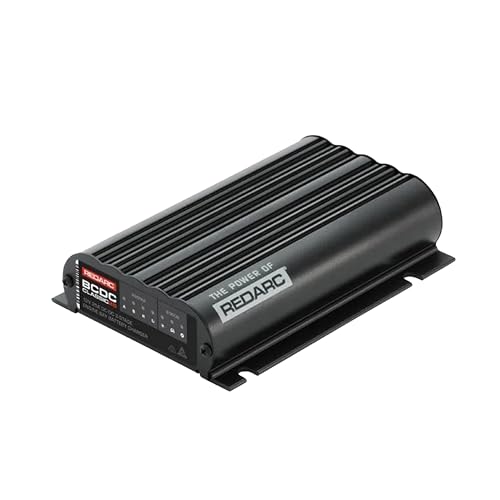
REDARC BCDC1225D 25A Dual Input DC-DC Charger with MPPT
The Australian touring standard, built for heat and corrugations rather than a garage. Green Power Priority takes solar first and only pulls from the alternator when solar cannot keep up.
Best for: Hot climates and hard-touring vehicles
Check priceVictron Orion-Tr Smart DC-DC Charger 12/12V 30A (Isolated)
The isolated version, which you need when the two battery negatives cannot be common, such as some boat and hybrid vehicle installations. Amazon stock on the isolated variants is inconsistent, so this opens a search.
Best for: Installations that require galvanic isolation
Find on AmazonPrices change often, confirm on Amazon. Products without a direct listing sell mainly through dealers, so those links open a scoped Amazon search. As an Amazon Associate we earn from qualifying purchases.
Why will an isolator not charge a lithium battery properly?
A voltage sensitive relay or a simple isolator does one thing: it closes a contact when the engine is running and connects the two batteries in parallel. That works acceptably for lead acid, which is tolerant of a partial charge, and it fails for lithium for two separate reasons.
First, voltage. LiFePO4 needs roughly 14.2 to 14.6V at the battery terminals to complete an absorption stage. Most alternator systems hold the starting battery near 13.8V, and after voltage drop down a long cable the house battery might see 13.5V. That charges a lithium pack to somewhere around 80 percent and then effectively stops, which is why so many builds report a battery that never seems to fill.
Second, current. A discharged LiFePO4 battery has very low internal resistance and will accept everything the alternator can produce, which on a directly connected 200Ah bank can mean the alternator running flat out for an hour in stop-start traffic with no airflow. Alternators are designed for intermittent peak output, not sustained maximum. A DC-DC charger caps its input current by design, which is the protective half of what it does. The DC to DC charging guide covers wiring the whole circuit, including the ignition trigger.
How big should a DC-DC charger be?
Two constraints set the answer: how much energy you need per driving hour, and what the alternator can sustain. Start from the bank. A common working rule is a charger rated between 20 and 50 percent of bank capacity in amps, so a 100Ah battery pairs with 20 to 50A and a 200Ah bank with 40 to 100A. Below 20 percent, driving barely moves the needle. Above 50 percent, the alternator becomes the limit rather than the charger.
Then check the drive. If your normal pattern is a 30 minute transit between camps, a 50A unit puts back roughly 25 amp-hours, which is most of a fridge day. If you routinely drive three hours, a 30A unit puts back 90 amp-hours and there is no reason to buy larger. Driving time is a real input to this decision and it is the one people skip.
Finally, sanity check the alternator. Six hundred watts of continuous charging plus headlights, a blower and a heated screen is a serious sustained ask on a small engine, particularly at idle where alternator output falls sharply. Vehicles with variable voltage smart charging complicate this further, which is exactly the case where a DC-DC charger with a proper ignition or D+ trigger earns its keep. Compare the whole approach against a roof array in the solar versus alternator charging comparison before you spend.
| Charger | Current | Approx watts | Cable, 20 ft run | Vdrop | Price |
|---|---|---|---|---|---|
| Renogy REGO 30A dual input | 30A | 360W | 4 AWG | 0.299V | $169.99 |
| Renogy Smart 50A dual input | 50A | 600W | 2 AWG | 0.312V | $253.03 |
| Renogy REGO 50A dual input | 50A | 600W | 2 AWG | 0.312V | $289.99 |
| Victron Orion XS 12/12-50 | 50A | 600W | 2 AWG | 0.312V | $299.98 |
| REDARC BCDC1225D | 25A | 300W | 4 AWG | 0.249V | $492.79 |
| Victron Orion-Tr Smart 12/12-30 isolated | 30A | 360W | 4 AWG | 0.299V | sold via dealers |
Watts are calculated at 12V nominal. Cable sizes are the smallest copper conductor that keeps voltage drop under the 3 percent target of 0.36V on a 20 foot one-way run at rated current, using Vdrop equals 2 multiplied by length, multiplied by current, multiplied by ohms per foot. Shorter runs allow one size smaller; longer runs need one size larger. The Victron isolated variant has inconsistent Amazon stock, so its link opens a scoped search.
What cable and fuse does the install actually need?
This is the part that decides whether the install is safe, and it is arithmetic rather than opinion. The run from the starting battery to the charger, and from the charger to the house battery, both carry full charge current continuously, and the engine bay leg runs through the hottest part of the vehicle.
Under ABYC E-11 for copper with 105C insulation outside engine spaces and three or fewer conductors in a bundle, 6 AWG carries 120A, 4 AWG carries 160A and 2 AWG carries 210A. Those are ampacity limits, not sizing targets. For a charger circuit, voltage drop almost always demands a larger conductor than ampacity does, because the run is long and the charger needs to see the source voltage it was designed around. Inside an engine space, derate those ampacity figures by roughly 30 percent.
Fuse both ends. A fuse at the starting battery protects the long positive cable from a chafe against the firewall, and a fuse at the house battery protects the same cable from a short at the other end, because the house battery can source hundreds of amps into a fault. Size each fuse above the charger's rated current, typically 60A for a 50A unit and 40A for a 30A unit, and always at or below the ampacity of the smallest conductor it protects. A marine rated MRBF terminal fuse at $9.99 bolts straight onto the battery post, which puts protection where it belongs: at the source, guarding the cable from the very first inch.
Use finely stranded tinned marine cable such as this 4 AWG marine grade battery cable at $79.16 rather than solid automotive wire, because vibration work-hardens coarse strands and damp corrodes untinned copper. Crimp lugs with a real hydraulic tool, not pliers. Check your own run length in the wire gauge calculator and cross reference the wire gauge ampacity chart before you cut anything.
Which DC-DC charger should most builds buy?
The Renogy Smart 50A DC-DC MPPT charger at $253.03 hits the size most van builds settle on, and it hits it with a solar input included. Fifty amps refills the 80 usable amp-hours of a 100Ah lithium battery in about two hours of driving, which is the specific thing that makes driving useful rather than incidental. Dual input means one device, one mounting location and one pair of fused feeds instead of two.
The Renogy REGO 50A at $289.99 is the same capability in the newer REGO housing, with tidier Bluetooth configuration and a modular mounting system. Buy it if you are building a whole REGO panel and want the components to line up physically; otherwise the $37 difference buys nothing electrical.
The Renogy REGO 30A at $169.99 is the right answer for a single 100Ah battery with a modest roof array and regular longer drives. Thirty amps is 360 watts, so an hour of driving returns roughly 30 amp-hours, which is a fridge day. Nothing about a smaller charger is a compromise if the driving pattern supplies the time.
Who should not buy the expert tier?
Do not buy the REDARC BCDC1225D at $492.79 for a vehicle that lives on pavement. It is the Australian touring standard because it is built for sustained heat and corrugations rather than a garage, and its Green Power Priority logic takes solar first and only pulls from the alternator when solar cannot keep up. That is excellent engineering, and at 25A it delivers half the charge current of a $253 Renogy. You are paying for durability in conditions most builds never see.
Do not buy the Victron Orion XS at $299.98 unless you already run VictronConnect or your charger lives in a sealed, heat-constrained cabinet. Around 98 percent efficiency is genuinely unusual for the class and it means noticeably less waste heat, which matters in a closed electrical bay. In an open, ventilated location behind a seat, the difference between 98 and 93 percent efficiency is roughly 30 watts of heat, which is real but not $47 of real for most people.
Do not buy the Victron Orion-Tr Smart isolated unless your installation actually requires galvanic isolation, meaning the two battery negatives cannot be common. That is a boat problem and a hybrid vehicle problem, not a van problem. If you do not know whether you need it, you do not need it. Amazon stock on the isolated variants is inconsistent, so that link opens a scoped search rather than a listing that may be gone.
What do people get wrong when installing one?
- Sizing the cable for ampacity and ignoring voltage drop. On a 20 foot run at 50A, 6 AWG is within its 120A ampacity and still drops 0.79V, more than double the target.
- Fusing only one end. Both batteries can source a fault current into the same cable, so both ends need protection.
- Forgetting the engine space derate. Ampacity falls roughly 30 percent under the hood, and that is where the cable is hottest and most chafed.
- Wiring the trigger to a permanent live. The charger must know when the engine is running, or it will drain the starting battery overnight.
- Charging a cold lithium bank. LiFePO4 cannot accept charge below freezing without heating, and a charger with no temperature sensor will not know.
- Skipping the ground path. The negative return needs the same conductor size as the positive, and a chassis ground point that is clean, tight and protected.
Once the charger is chosen, the battery it feeds is the next decision, and the two need to agree on charge voltage and temperature protection. Start with the lithium battery roundup and confirm the absorption voltage in the battery datasheet matches what your charger's lithium profile actually outputs. Mismatched profiles are the quiet reason a healthy bank never reaches full.
Frequently asked questions
Why do I need a DC-DC charger instead of a simple battery isolator?
An isolator just connects two batteries together, so the house battery only ever reaches whatever the alternator holds the starting battery at, usually around 13.8V. LiFePO4 wants roughly 14.2 to 14.6V to reach a full charge, so an isolated lithium bank stalls near 80 percent forever. A DC-DC charger converts voltage instead of connecting, delivering the correct charge profile and limiting current so the alternator is not overloaded.
What size DC-DC charger do I need?
Match it to bank size and driving time. A common rule is 20 to 50 percent of bank capacity in amps, so a single 100Ah battery suits 30A and a 200Ah bank suits 50A. Fifty amps is roughly 600 watts, which refills 80 usable amp-hours in about two hours of driving. Going larger only helps if the alternator can supply it continuously without overheating.
What cable size does a 50A DC-DC charger need?
For a 20 foot one-way run at 50A on 12V, 2 AWG keeps voltage drop at 0.312V, inside the 3 percent target of 0.36V. Halve the run to 10 feet and 4 AWG gives 0.249V and is fine. The formula is Vdrop equals 2 multiplied by run length, multiplied by current, multiplied by ohms per foot. The factor of two exists because current flows out and back.
Will a DC-DC charger damage my alternator?
A correctly sized one will not, but a large one on a small alternator can. A 50A charger asks the alternator for roughly 600 watts continuously on top of the vehicle load, at idle as well as at highway speed, and alternators are cooled by engine bay airflow rather than by fan speed. If your vehicle has a small alternator or a smart variable-voltage system, check the manufacturer guidance before fitting anything above 30A.
Do I need the MPPT solar input version?
It is usually worth it. A dual input unit handles alternator and solar in one box, which means one device, one mounting location and one set of fuses instead of two. The compromise is that a combined unit ties both charging sources to one product, so a failure takes out both. Separate units are more resilient and take more space and more wiring.
Can a DC-DC charger charge a lithium battery below freezing?
It will try, and that is the problem. LiFePO4 cannot safely accept charge below 32F, so cold charging either damages the cells or, on a good battery, is blocked by the battery management system. Use a self-heating battery, an external heat pad, or a charger with a temperature sensor input that suspends charging when the pack is cold. Discharging below freezing is fine.
Electrical safety: 12V is low voltage but not low energy. A lithium house battery can push several hundred amps into a short circuit, and undersized or unfused cable is one of the most common causes of vehicle fires in DIY builds. Every circuit must be fused at the source of power, within a few inches of the battery terminal, at or below the ampacity of the smallest conductor it protects. Size cable for voltage drop as well as ampacity, torque terminals to specification, and have a lithium installation inspected by a qualified installer before it carries load. The figures on this page are researched guidance, not a substitute for ABYC E-11 or your component manufacturer's installation manual.
How we choose: we compare published manufacturer specifications, standards documents including ABYC E-11, and verified owner reviews. We do not test gear in person. Vehicle payload, roof load and charging limits vary by model and year, so confirm yours against the door jamb sticker and the owner's manual rather than any number published here.
Totalling your own build weight against your payload? The Overland Build & Power Planner is the paid version of these pages: 8 printable worksheets you fill in with your own numbers, plus the full PDF, $29.