Solar vs Alternator Charging: Why You Need Both
A 400W roof array returns about 117 amp-hours on a five sun hour summer day and about 47 in midwinter, while a 50A DC-DC charger returns 100 amp-hours from a two hour drive in any season. Buy both, and buy the DC-DC charger first: most builds over-buy solar and under-buy alternator charging, because solar is the visible half.
These are not competing options, they are two charge sources with opposite failure modes, and the right build has both. Buy the DC-DC charger first and buy it bigger than feels necessary, then add solar to cover the days you do not drive. Solar is free energy that disappears in winter, under trees and under cloud. Alternator charging is reliable, seasonal-proof and entirely absent the moment the vehicle stops moving. Most builds get this backwards, buying a fourth panel instead of stepping up the charger.
Start with what each source physically is. A solar array converts light into current, and it does that whenever there is light, with no moving parts and no fuel, for as long as the panels last. A DC-DC charger converts alternator output into a properly regulated lithium charge, at a current you set, whenever the engine is running. One depends on the sky, the other depends on your itinerary, and neither one is reliable on its own.
How much does each source actually deliver in a day?
Put them side by side on the same axis, which is hours. For solar that axis is sun hours, the equivalent number of hours at full rated irradiance, which is not the same as hours of daylight. For the alternator it is hours the engine is running. The solar column below is a 400W flat roof array through an MPPT controller, using the working derate of panel watts times sun hours times 0.75, converted at 12.8V nominal. The alternator column is a 50A DC-DC charger.
| Hours | 400W array, Ah delivered | 50A DC-DC, Ah delivered |
|---|---|---|
| 0.5 | 12 | 25 |
| 1.0 | 23 | 50 |
| 1.5 | 35 | 75 |
| 2.0 | 47 | 100 |
| 3.0 | 70 | 150 |
| 4.0 | 94 | 200 |
| 5.0 | 117 | 250 |
| 6.0 | 141 | 300 |
| 7.0 | 164 | 350 |
Per hour, the alternator wins comfortably: about 50 amp-hours against about 23. That is the whole reason a DC-DC charger transforms a build. Two hours of driving between camps, which most people do anyway without thinking of it as charging, puts 100 amp-hours back. That is a full 100Ah lithium bank from empty, in a window you were spending regardless.
But look at where the two columns actually sit in a real day. A 400W array will genuinely see five sun hours on a clear summer day, so 117 amp-hours is achievable with the vehicle parked and nobody present. Very few people drive five hours a day on a trip. The honest comparison is therefore between a 400W array at four to six hours and a DC-DC charger at one to two hours, which puts them roughly level in summer, and nowhere near level in winter.
<!-- gift-guides-xlink -->What happens to solar across the seasons?
It collapses, and the collapse is steeper than most people plan for. Sun hours fall with the season for three reasons stacking together: fewer daylight hours, a lower sun angle so a flat roof panel presents a poor face to it, and more cloud. The table below runs a 400W array against a fairly typical 60 amp-hour daily load, which is a compressor fridge, lighting, a fan and device charging.
| Condition | Sun hours | 400W array, Ah/day | Shortfall vs 60Ah load | Drive hours to close it |
|---|---|---|---|---|
| Midwinter, high latitude | 1.5 | 35 | 25 | 0.5 |
| Midwinter, mid latitude | 2.0 | 47 | 13 | 0.3 |
| Late winter | 3.0 | 70 | 0 | 0.0 |
| Spring | 4.5 | 105 | 0 | 0.0 |
| Midsummer, mid latitude | 6.0 | 141 | 0 | 0.0 |
| Midsummer, desert southwest | 7.0 | 164 | 0 | 0.0 |
| Autumn, overcast week | 1.0 | 23 | 37 | 0.8 |
| Any season, parked in trees | 0.5 | 12 | 48 | 1.0 |
Read the last column, because that is the whole argument of this page. In every deficit case, half an hour to an hour of driving with a 50A DC-DC charger closes the gap completely. Not a bigger array, not a second battery, not rationing: a short drive. A 400W array in midwinter at high latitude delivers 35 amp-hours where the load is 60, and no realistic amount of additional roof fixes that, because the problem is the sun rather than the panels.
The tree-shade row is worth noticing separately, because it is the one that catches people in summer. A shaded roof array produces very little, and campsites in hot weather are chosen for shade. That is not a winter problem, it is a midsummer problem, and it is one of the strongest arguments for keeping one movable panel that can sit in a sunny patch fifty feet away. The portable versus roof-mounted solar comparison covers that trade properly, and the sun hours by region chart gives figures for where you actually travel.
What does each source cost per delivered amp-hour?
Both sources are capital costs with no running cost, so the fair comparison is dollars spent against amp-hours delivered per day. The solar figures below include the panels, the MPPT controller and the mounting and cable hardware, because none of those are optional. The charger figures include the charger only, since it uses the same cable and fusing conventions as the rest of the system.
| Charge source | Installed cost | Summer Ah/day | Winter Ah/day | Cost per summer Ah/day | Cost per winter Ah/day |
|---|---|---|---|---|---|
| 400W roof array with MPPT | $522.03 | 117 | 47 | $4.46 | $11.11 |
| 200W roof array with MPPT | $345.69 | 59 | 23 | $5.86 | $15.03 |
| 30A DC-DC charger, 2 hr drive | $169.99 | 60 | 60 | $2.83 | $2.83 |
| 50A DC-DC charger, 2 hr drive | $253.03 | 100 | 100 | $2.53 | $2.53 |
| 50A DC-DC charger, 1 hr drive | $253.03 | 50 | 50 | $5.06 | $5.06 |
| 50A DC-DC charger, parked all week | $253.03 | 0 | 0 | no output | no output |
A 50A DC-DC charger at $253.03 buys charging capability at $2.53 per daily amp-hour on a two hour drive, and that figure does not change with the season. A 400W array with a Victron SmartSolar 100/30 , two 200W panels and the mounting hardware costs $4.46 per daily amp-hour in summer and $11.11 in winter. On dollars alone, the charger wins in every season.
The last row is why the charger does not win the argument outright. A DC-DC charger delivers exactly nothing while parked, and the whole point of an off-grid build is often to stay parked. Solar has the enormous advantage of working on the days you are not going anywhere, which is when a battery bank is actually being tested. That is why the answer here is both, in a specific order: buy the charger first because it is cheaper per amp-hour and season-proof, then add as much solar as the roof takes.
Why is a DC-DC charger not optional on a modern vehicle?
Because the alternator in a current vehicle is not a dumb device putting out a steady 14.4V. On a Euro 6 diesel, a stop-start petrol or any vehicle with a variable-voltage or so-called smart alternator, the engine control unit manages charging output as part of fuel economy strategy. It monitors the starter battery through a current sensor on the negative terminal, and once it decides that battery is full, it drops alternator output to somewhere around 12.3 to 12.6V and leaves it there, recovering energy under braking instead.
A lithium house bank needs roughly 14.2 to 14.6V to charge. At 12.5V it takes essentially nothing. So a traditional split-charge relay on a modern vehicle connects the two batteries together and then delivers almost no charge, while the owner watches a monitor and concludes the relay is faulty. It is not faulty, it is doing exactly what it was built to do in a vehicle whose alternator no longer behaves the way relays assume.
A DC-DC charger solves this by boosting. It takes whatever the alternator is offering, including 12.3V, and produces a correct lithium charge profile out the other side at a current you set. That is the first reason it is mandatory. The second reason is protection in the other direction: a discharged LiFePO4 pack has very low internal resistance and will accept everything the alternator can produce, continuously. Alternators are rated for peak output at road speed with airflow, not sustained maximum in traffic, so a direct connection is a good way to cook one. A charger limits the draw to its own rating no matter how empty the bank is.
Third, it isolates. The house bank and the starter battery are separated whenever the engine is off, so a house bank flattened by a fridge cannot leave you unable to start the vehicle. That alone justifies the component. The DC-DC charging guide covers the ignition-sense wiring, the engine-running detection options and the cable sizing for the under-hood run.
Which charger and which array?
For most 100Ah to 200Ah builds the answer is 50A, because 50A is roughly 600W of charging and refills a flat 100Ah bank in about two hours. The Renogy Smart 50A dual input at $253.03 is the default, and it takes solar into the same box. The Victron Orion XS 50A at $299.98 is around 98 percent efficient, which is unusually high for the class and means noticeably less heat in a sealed cabinet, and it configures alongside the rest of a Victron system.
On a single 100Ah battery with a modest array, the Renogy REGO 30A dual input at $169.99 is enough, and it is the right call on an older vehicle with a small alternator. In hot climates and on genuinely hard touring, the REDARC BCDC1225D is built for heat and corrugations rather than a garage, and its Green Power Priority behaviour takes solar first and only pulls from the alternator when solar cannot keep up, which is exactly the logic this page argues for.
On the solar side, 200W panels are the sensible unit size for a vehicle roof: twice the output of a 100W panel for roughly the same mounting effort and half the roof penetrations per watt. Two Renogy 200W panels make the 400W array used throughout this page. Add one movable panel such as the Jackery SolarSaga 100W for shade and winter, where a panel you can aim substantially outproduces a flat one.
DC-DC chargers by build size

Renogy REGO 12V 30A DC-DC Charger with MPPT (Dual Input)
Alternator and solar into one unit at the smallest sensible current for a single 100Ah battery. Dual input means one device, one set of fuses and one less thing to find space for.
Best for: A single 100Ah lithium battery with a modest roof array
Check price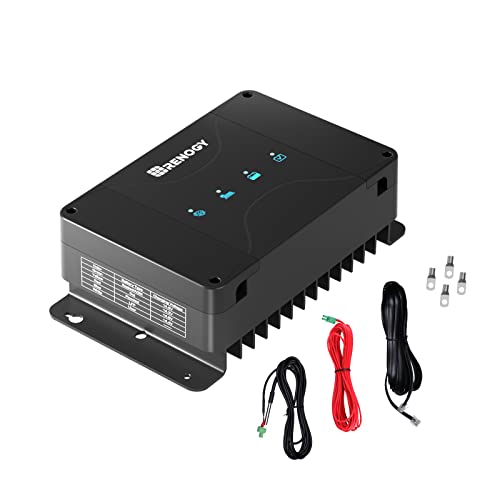
Renogy Smart 50A DC-DC MPPT Battery Charger 12V (Dual Input)
Fifty amps is roughly 600W of charging, which refills a 100Ah bank in about two hours of driving. This is the size most van builds settle on, and it is the one that makes drive time genuinely useful.
Best for: Most 100Ah to 200Ah builds
Check price Renogy REGO 12V 50A DC-DC Charger with MPPT (Dual Input)
The REGO generation of the same 50A capability, with tidier Bluetooth configuration and a modular mounting system if you are building a whole REGO panel.
Best for: Builds standardising on the Renogy REGO ecosystem
Check price
Victron Orion XS Smart DC-DC Charger 12/12V 50A (Bluetooth)
Around 98% efficient, which is unusually high for the class and means noticeably less heat in a sealed cabinet. Configures and monitors through VictronConnect alongside the rest of a Victron system.
Best for: Victron-based systems and heat-constrained installs
Check pricePrices change often, confirm on Amazon. Products without a direct listing sell mainly through dealers, so those links open a scoped Amazon search. As an Amazon Associate we earn from qualifying purchases.
Who should choose which, and in what order?
Prioritise alternator charging if you move most days, camp in winter or at high latitude, park in trees or in canyons, travel in a vehicle whose roof is already full, or run a load that solar cannot cover in your season. Prioritise it if you have a modern vehicle at all, because on a smart alternator the DC-DC charger is what makes alternator charging exist rather than what makes it better.
Prioritise solar if you park for days at a time, travel in summer at low latitude, have roof area doing nothing, or run a build where the vehicle sits at a trailhead for a long weekend while you are elsewhere. Solar is also the only source that works while the vehicle is in storage, which quietly keeps a bank healthy between trips.
Who should not spend the money: if you are running a sealed power station rather than a wired system, a 50A DC-DC charger has nothing to connect to, and the money belongs in a portable panel instead. And if your total daily consumption is under 20 amp-hours, which is a build with no fridge, a 400W array and a 50A charger are both several times more charging than you will ever use. Measure the load first with a AstroAI Digital Clamp Meter, AC/DC Current and Voltage (4000 count) or work it through the power consumption calculator, because every number on this page is only meaningful against a real daily figure.
How the two sources should be wired together
Keep them independent where you can. A dual-input unit that combines MPPT and DC-DC in one box saves space, one mounting location and one set of fuses, and it is the right answer in a tight build. The cost is that both charge sources now share a failure, and losing both at once in a remote place is a different kind of problem from losing one.
If you separate them, the array feeds its own controller and the alternator feeds its own charger, and both outputs land on the same positive busbar with their own fuses. A pair of 250A busbars makes that tidy and torqueable, and a resettable breaker on the solar leg lets you isolate the roof without going up there. Fit a shunt battery monitor so you can see which source actually contributed what, because the history is how you discover that your array stopped producing at eleven in the morning because the bank was already full.
On the battery side, remember that charge acceptance is a property of the battery too. A self-heating LiFePO4 pack will accept its full rated current down to freezing and then let the heater run off the incoming charge, which is exactly the behaviour you want when the alternator is doing the work in winter. Without self-heating, the coldest days are the days when both charge sources are equally useless, because the battery refuses everything they offer. The winter camping power guide covers that case in full.
One last consideration that people meet only after the build is finished: the two sources compete for the same space at the top of the charge curve. Once the bank is full, both sources stop contributing, so an oversized array and an oversized charger cannot both be busy. If your shunt history shows the array idling by late morning on most days, the useful next purchase is storage or nothing at all, not another panel. That single habit of reading the history before buying is worth more than any figure on this page.
Where to go next
- The DC-DC charging guide, for the wiring, the fusing and the ignition sense.
- The DC-DC charger roundup, with picks by bank size and climate.
- Solar output by sun hours, for the array figures behind this page.
- Sun hours by region, so you can use your own numbers rather than these.
- Portable versus roof-mounted solar, which is where the winter shortfall gets partly recovered.
- BLUETTI AC200L review, the single-product review.
- Jackery Explorer 2000 Plus review, the single-product review.
Frequently asked questions
Which charges faster, solar or the alternator?
The alternator, by a wide margin, per hour of operation. A 50A DC-DC charger delivers 50 amp-hours for every hour the engine runs, where a 400W roof array delivers roughly 23 amp-hours per hour of usable sun. The catch is that the array works for four to six hours on a good day with nobody doing anything, while the alternator only works while you are actually driving.
Why do most builds under-buy the DC-DC charger?
Because solar is visible and satisfying and a DC-DC charger is a grey box behind a panel. People add a fourth panel rather than stepping from a 30A charger to a 50A charger, even though the 50A charger returns 100 amp-hours from a two hour drive that was happening anyway, and the fourth panel returns about 29 amp-hours on a good summer day and about 12 in midwinter.
Do I really need a DC-DC charger, or will a relay work?
On a modern vehicle you need the charger. Variable-voltage and stop-start alternators reduce output to around 12.3 to 12.6V once the engine control unit decides the starter battery is full, which is below the voltage a lithium house bank needs to charge at all. A simple split-charge relay will connect the two batteries and then deliver almost nothing, and it also gives the lithium bank an unlimited path to the alternator.
Can a lithium battery damage my alternator?
Yes, if it is connected directly. A discharged LiFePO4 pack has very low internal resistance and will accept everything the alternator can produce, indefinitely. Alternators are rated for peak output with airflow at road speed, not for sustained maximum output in traffic, so the result is heat and shortened life. A DC-DC charger limits the draw to its own rating regardless of how empty the house bank is, which is the protection.
How big should the DC-DC charger be?
Match it to your bank and your typical drive. Fifty amps refills a 100Ah lithium bank in roughly two hours of driving, which suits most builds. Thirty amps suits a single 100Ah battery on longer drives and a smaller alternator. Going above 50A on a 12V system means checking the alternator rating seriously, because a 60A charger asks for something close to 70A of alternator output continuously.
Should the solar and the alternator share one device?
Dual-input units combine an MPPT controller and a DC-DC charger in one box, which saves space, one set of fuses and one mounting location. The trade is that both charge sources now fail together, and if the unit dies you lose everything at once. On a build where redundancy matters, separate units on separate fuses are the more robust arrangement even though they cost a little more and take more room.
Electrical safety: 12V is low voltage but not low energy. A lithium house battery can push several hundred amps into a short circuit, and undersized or unfused cable is one of the most common causes of vehicle fires in DIY builds. Every circuit must be fused at the source of power, within a few inches of the battery terminal, at or below the ampacity of the smallest conductor it protects. Size cable for voltage drop as well as ampacity, torque terminals to specification, and have a lithium installation inspected by a qualified installer before it carries load. The figures on this page are researched guidance, not a substitute for ABYC E-11 or your component manufacturer's installation manual.
How we choose: we compare published manufacturer specifications, standards documents including ABYC E-11, and verified owner reviews. We do not test gear in person. Vehicle payload, roof load and charging limits vary by model and year, so confirm yours against the door jamb sticker and the owner's manual rather than any number published here.
Totalling your own build weight against your payload? The Overland Build & Power Planner is the paid version of these pages: 8 printable worksheets you fill in with your own numbers, plus the full PDF, $29.