Best Rooftop Tent: Picks by Weight, Not by Looks
The WildFinder hard shell at $1,099.00 is the best rooftop tent for most builds: it opens in about thirty seconds and its low closed profile costs far less fuel economy than a folded soft shell. Before buying any of them, check the weight. Rooftop tents run 110 to 165 lb before the rack, and the dynamic roof load limit they have to fit inside is typically only 150 to 220 lb.
For most vehicles the right answer is the WildFinder Hard Shell Rooftop Tent at $1,099.00, because it is the cheapest honest way into a hard shell, where the tent opens in about thirty seconds and the closed profile does far less damage to fuel economy than a folded soft shell. But the number that should decide this purchase is not the price and it is not the setup time. It is the weight.
A rooftop tent is a sleeping platform with a folding or hinged fabric structure that mounts to a vehicle roof rack, so you sleep above the ground rather than on it. That is the whole appeal: a flat bed on uneven or wet ground, no site to clear, and a mattress that stays in place between trips. It is a genuinely good idea and it is also the single heaviest thing most people ever bolt to a vehicle.
Say that plainly, because the category rarely does. A rooftop tent weighs 110 to 165 lb before you add the rack, and it sits at the worst possible place on the vehicle for handling and rollover resistance. Weight low in the chassis barely changes how a vehicle behaves. The same weight six feet up raises the centre of gravity, lengthens the lever the suspension has to control in a corner, adds roll inertia in an avoidance manoeuvre and reduces the margin before a vehicle goes over instead of sliding. This is not a reason to avoid a rooftop tent. It is the reason weight belongs at the top of the page rather than in a specification footnote.
Best rooftop tents by build stage
Meedo Apolle A86 M Soft Shell Rooftop Tent (2 Person)
Soft shell tents are lighter and cheaper than hard shells and sleep the same number of people. The cost is setup time, roughly five minutes each way against about thirty seconds for a hard shell.
Best for: A first rooftop tent, and lighter roof racks
Check price
Smittybilt Overland GEN2 Rooftop Tent (Standard)
The tent that made rooftop camping mainstream in the US, and still the most widely supported one for spare parts and aftermarket annexes. Heavy for a soft shell at around 120 lb.
Best for: Availability of parts and accessories
Check price
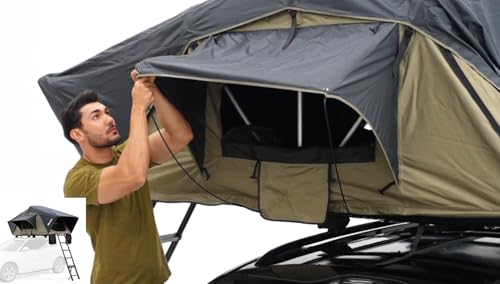
WildFinder Hard Shell Rooftop Tent (Jeep, SUV, Truck, Van)
The entry point into hard shells, where the tent opens in seconds and the closed profile does far less damage to fuel economy than a folded soft shell.
Best for: Frequent single-night stops
Check price
JOYINRUTE Hard Shell Rooftop Tent with Winter Insulation
Insulated shell and fabric, which is the difference between a shoulder-season tent and a genuinely four-season one. Condensation management is the real cold-weather problem and insulation is most of the answer.
Best for: Cold weather and shoulder-season trips
Check price
Thule Tepui Explorer Kukenam 3 Rooftop Tent
Thule’s rack engineering and warranty support behind a three-person soft shell, with fabric quality that shows up after several seasons of UV rather than on day one.
Best for: Three people, and long-term durability
Check priceiKamper Skycamp 3.0 Hard Shell Rooftop Tent
The reference hard shell, with a fold-out floor that sleeps four in a closed footprint the size of a two-person tent. iKamper sells through its own dealer network, so this opens a scoped search.
Best for: Four people without a trailer
Find on AmazonPrices change often, confirm on Amazon. Products without a direct listing sell mainly through dealers, so those links open a scoped Amazon search. As an Amazon Associate we earn from qualifying purchases.
How much does a rooftop tent weigh, and why does that decide everything?
Soft shell tents run roughly 110 to 140 lb. Hard shells run roughly 125 to 165 lb. Those ranges are the whole reason this page is ordered the way it is, because the tent is not the only thing going on the roof. The rack it bolts to is another 25 to 90 lb depending on whether you fit an aftermarket crossbar pair or a full platform, and a platform rack can reach 110 lb on its own. Both numbers count against the same limit.
That total lands inside a payload budget that is smaller than almost everyone expects. A mid-size truck with a 5,600 lb gross vehicle weight rating and a 4,480 lb curb weight has 1,120 lb of payload, and payload covers occupants, water, fuel in cans and the entire build. Two adults are 300 to 400 lb of that. A rack plus a tent is another 200 lb or so. Before a battery, a fridge or a drawer system exists, over half the budget is committed. Work your own vehicle through the payload weight calculator and read the payload and GVWR guide before you choose a tent, not after. That is the order that saves money.
There is a second, stricter limit stacked on top of the payload one, and it is the limit that rooftop tents actually break. Weight on a roof is governed by its own rating, separately from what the vehicle as a whole may carry, and that rating is far lower than people assume. The next section is the important one on this page.
Within the six tents here, the weight spread is worth about 50 lb from lightest to heaviest, which is not a rounding error when the ceiling is 165 lb. The Meedo Apolle A86 M at $999.99 sits at the light end of the soft shell range and is the correct choice on a vehicle with modest crossbars. The JOYINRUTE insulated hard shell at $1,359.00 sits at the heavy end, because insulation is mass, and it is the one to check your roof rating against most carefully. The full spread, with the rack weights to add on top, is in the rooftop tent weight chart.
| Tent | Type | Sleeps | Approximate weight, lb | Price |
|---|---|---|---|---|
| Meedo Apolle A86 M | Soft shell, fold-over | 2 | 110 to 125 | $999.99 |
| Smittybilt Overland GEN2 Standard | Soft shell, fold-over | 2 to 3 | about 120 | $1,100.61 |
| WildFinder Hard Shell | Hard shell, clamshell | 2 | 125 to 145 | $1,099.00 |
| JOYINRUTE Hard Shell, insulated | Hard shell, clamshell | 2 | 140 to 165 | $1,359.00 |
| Thule Tepui Explorer Kukenam 3 | Soft shell, fold-over | 3 | 125 to 140 | $1,999.95 |
| iKamper Skycamp 3.0 | Hard shell, fold-out | 4 | 155 to 165 | Sold direct |
A note on that weight column, because honesty here matters more than a tidy table. Only one of these figures comes from the product data itself: the Smittybilt GEN2 is described as heavy for a soft shell at around 120 lb. The rest are category ranges for that style and sleeping capacity, given as ranges precisely because we are not willing to publish a manufacturer weight we cannot verify. Confirm the exact figure on the listing or the manufacturer specification sheet for the variant you are buying, since the same model name often covers two or three sizes with a 20 lb spread between them. Prices move, so check those too.
Hard shell or soft shell, which should you actually buy?
A soft shell folds over the side of the rack like a book and is covered by a fitted travel cover. A hard shell has a rigid lid, usually fibreglass or moulded plastic, that lifts on struts or hinges. That structural difference produces every trade in the category.
Setup time is the headline. A hard shell opens in roughly thirty seconds: release two latches and the struts do the work. A soft shell is about five minutes each way, because you remove the cover, unfold the tent, position the ladder, then fit the rain fly poles. Five minutes is nothing once. Five minutes twice a day for a fortnight of moving camp is a different proposition, particularly in rain or after dark.
Closed profile and fuel economy come second. A folded soft shell with its cover on stands roughly 12 to 17 inches above the rack and presents a blunt, slightly baggy face to the air. A hard shell closes to roughly 7 to 12 inches with a smooth moulded top. The difference commonly shows up as one to two miles per gallon at highway speed, in favour of the hard shell, and it also decides whether you fit under the parking structure at your office.
Price and weight go the other way. A soft shell of the same sleeping capacity is usually 20 to 40 lb lighter and several hundred dollars cheaper. That is the trade in one sentence, and it is why the answer is not simply "buy the hard shell". Look at the Thule Tepui Explorer Kukenam 3 at $1,999.95 against the iKamper Skycamp 3.0 : both are premium tents, one sleeps three in fabric and one sleeps four behind a hinged shell, and the shell costs more and weighs more for the same square footage per person.
Interior space when open favours the soft shell. A fold-over design cantilevers a whole second floor panel out over the side of the vehicle, so its open footprint is roughly twice its closed footprint. A clamshell hard shell opens upward within its own footprint, so what you see closed is what you sleep in. The exception is a fold-out hard shell like the Skycamp, which combines a rigid lid with a hinged floor and gets both, at the cost of being the heaviest and most expensive format on the market.
If you want that comparison worked through dimension by dimension, with the fuel economy, condensation and resale arguments in full, read hard shell versus soft shell rooftop tent. The short version: hard shell if you move every day, soft shell if you park for several nights, and soft shell if your roof rating is tight.
What is a rack load rating, and why are there two of them?
Dynamic roof load is the maximum weight a roof may carry while the vehicle is moving. Static roof load is the maximum while parked. The static figure is dramatically higher, commonly 600 to 800 lb and more on some vehicles, because a parked roof carries only the weight itself. A moving roof carries that weight multiplied by whatever the road does to it: braking, cornering, a compression over a water bar, a pothole at 60 mph.
Dynamic roof load on a standard vehicle is typically 150 to 220 lb. That is the number a tent purchase has to fit inside, and it is the reason a two person tent can legitimately sleep 400 lb of adults on a roof rated 165 lb for driving. Both facts are true at once. The tent is only loaded to its sleeping weight when the vehicle is stationary.
Two things count against the dynamic figure, and people consistently remember only the first. The tent weight and the rack weight both count. A platform rack at 70 lb plus a hard shell at 135 lb is 205 lb, which is over a 165 lb limit before an awning, a solar panel, a shovel or a fuel can joins the party. The rack is not part of the vehicle. It is cargo, and it is cargo that spends its whole life up there.
Then there is the second limit, which is separate and easy to miss. The vehicle roof rating and the aftermarket rack rating are two different numbers, and the lower one governs. A platform rack rated 300 lb dynamic on a vehicle rated 165 lb gives you 165 lb, not 300. The rack rating tells you what the rack will survive, not what the roof structure beneath it will. Bed racks and canopy racks are the genuine exception, because they transfer load into the bed rails or the frame rather than into a roof panel, and their ratings are frequently 500 lb or more. That is why a truck owner with a payload problem often solves the roof problem by moving the tent off the roof entirely. The roof rack load and dynamic capacity guide works through mounting types and how each one transfers weight.
| Roof setup | Rack, lb | Tent and accessories, lb | Total on the roof, lb | Margin against 165 lb | Verdict |
|---|---|---|---|---|---|
| Aftermarket crossbar pair plus light soft shell | 32 | 115 | 147 | 18 | Inside the limit |
| Platform rack plus light soft shell | 70 | 115 | 185 | -20 | Over the limit |
| Platform rack plus heavy soft shell | 70 | 130 | 200 | -35 | Over the limit |
| Platform rack plus entry hard shell | 70 | 135 | 205 | -40 | Over the limit |
| Platform rack plus insulated hard shell | 70 | 155 | 225 | -60 | Over the limit |
| Platform rack, hard shell and a 270 degree awning | 70 | 220 | 290 | -125 | Over the limit |
Read the first row and the third. Light crossbars plus a light soft shell leaves genuine headroom. A platform rack plus a heavy soft shell has already used the whole allowance. That single change, crossbars instead of a platform, is worth about 38 lb and costs nothing in capability if you were only ever going to mount a tent. The 165 lb figure used here is the default in the payload calculator and it is illustrative: substitute the dynamic figure from your own owner manual, because it is the only one that applies to your vehicle.
How many people does a rooftop tent really sleep?
Rated capacity is derived from mattress width, at roughly 20 to 22 inches per person. A standard twin mattress is 38 inches wide for one adult, so a two person rooftop tent at about 48 inches is closer to a very tight double than to two beds. The practical rule is to subtract one from the rating if you want anyone to sleep well.
In the inventory that means the WildFinder hard shell and the JOYINRUTE insulated shell are honest two adult tents with nowhere to put a bag. The Smittybilt Overland GEN2 at $1,100.61 is rated for two to three and works as two adults plus gear or two adults and a small child. The Thule Tepui Kukenam 3 is a genuine three person soft shell, which in practice is the comfortable two person tent most couples actually want. The iKamper Skycamp 3.0 sleeps four in a closed footprint the size of a two person tent, which is the specific problem it exists to solve and the reason families buy it instead of a trailer.
Length matters as much as width and is quoted less often. Anyone over about six feet two should check interior length rather than assume, particularly on clamshell hard shells where the shell tapers toward the foot end. Headroom is the other overlooked dimension: a clamshell that lifts on struts is highest at the hinge and lowest at the front, so sitting up to get dressed may only be possible at one end.
Is the mattress any good, and what do you do about condensation?
Included mattresses are usually 2 to 3 inches of open cell foam, which is adequate on a rigid floor and mediocre on a fabric floor that flexes between supports. Most people who keep a tent for more than a season add a self-inflating pad or a topper on top of the original foam. Budget for that rather than being disappointed by it, and remember that anything you leave in the tent folds up inside it, which is one of the real advantages of the format and also a reason the closed height creeps upward.
Condensation is the actual quality-of-life problem in a rooftop tent, and it is physics rather than a defect. Two sleeping adults exhale and perspire something like a litre of water overnight. In a tent with a warm interior and a cold outer surface, that vapour condenses on the coldest thing available. In a soft shell that is the underside of the rain fly, where it can drip through mesh. In a hard shell it is the inside of the shell itself, which is a smooth cold panel directly above your face.
The fixes are all ventilation and insulation. Crack windows at both ends so air moves through rather than sitting still, sleep with the rain fly vents open even when it is cold, and fit an anti-condensation mat under the mattress so the underside of the foam is not sitting against a cold floor with no air gap. Insulation on the shell itself is the structural version of the same fix, which is exactly what the JOYINRUTE insulated shell is paying for. A low draw fan or a set of 12V lights on a switch also earns its place here, because the alternative to opening a vent is usually going to bed with a wet ceiling.
Do you need an annex, and does the tent work with an awning?
An annex is a fabric room that zips to the underside of the tent floor and encloses the space around the ladder, giving you a standing changing room, a place to put boots out of the rain and somewhere to run a shower. It is the accessory that most changes how a rooftop tent feels to live in, and it is also 20 to 35 lb of extra fabric to store and several minutes of extra setup. Annex availability is one of the strongest practical arguments for the Smittybilt Overland GEN2 , which has the widest aftermarket support in the category for exactly this kind of part.
Awning integration is a separate and more common decision. A tent gives you somewhere to sleep and an awning gives you somewhere to exist during the day, which is why almost every build ends up with both. The catch is that a 270 degree awning at $520.52 is another 55 to 90 lb, and if it mounts to the same roof rack as the tent it counts against the same dynamic limit. That is the last row of the table above, and it is over the limit by a wide margin.
Two answers work. Mount the awning to body brackets or to a bed rack rather than the roof rack, which takes its weight off the roof entirely. Or choose a free standing awning, which does not need legs planted in the ground and is easier to site alongside an open tent. The vehicle awning roundup covers the formats and which mounting each one suits.
Which rooftop tents are genuinely four season?
Most rooftop tents are three season tents with good wind performance, which is not the same thing. A four season claim should mean three specific things: fabric heavy enough to hold heat and shed snow load, an insulated shell or an insulation liner so the coldest interior surface is not bare fibreglass, and enough vent area that you can manage condensation without opening the tent to the weather.
The JOYINRUTE hard shell with winter insulation at $1,359.00 is the one in this set built around that specification, with insulation in both the shell and the fabric. The insulation is the point: it raises the temperature of the surface your breath condenses on, which is most of the cold weather problem solved at the source instead of managed with a towel. The trade is weight, since insulation is mass, and it puts this tent at the heavy end of the range.
Everything else about winter use happens outside the tent. Snow load on an open tent is real and a hard shell handles it better than a fly on poles. Zips freeze, so lubricate them. And a cold night is when a 12V system matters most, which is worth reading up on separately because lithium batteries cannot accept charge below freezing without a self-heating cell or a heat pad.
What is a rooftop tent genuinely worse at than a ground tent?
Plenty, and a roundup that does not say so is not useful. You cannot leave camp without packing up. That is the big one. A ground tent stays pitched while you drive to a trailhead, go for supplies or move the vehicle out of the sun. A rooftop tent goes where the vehicle goes, every time, which means every departure is a pack-down and every return is a setup.
It is worse on weight, by 100 lb or more against a good ground tent, and that weight is in the worst place. It costs fuel economy every mile of every trip, including the commuting miles between trips. It costs three to five times the money: a capable two person ground tent is $200 to $400 against $1,000 to $2,000 here, and it needs no rack. It requires a ladder in the dark for anyone getting up at night, which is a genuine consideration for older travellers, children and anyone with a knee. It is loud in wind, because fabric drums against a rigid frame you are lying on rather than against pegs in soft ground. And it limits where you can park under trees, in parking structures and at some drive-through gates.
What it gives back is a flat, dry, level bed on ground that would be miserable in a ground tent, thirty seconds to bed in a hard shell, no site to clear, bedding that stays made, and separation from mud, water and anything crawling. For someone who camps often, in variable weather, moving every day or two, that trade is comfortably worth it. For someone who camps three weekends a year on grass, it is not.
Who should not buy the expert tier?
Do not buy the iKamper Skycamp 3.0 unless you genuinely need to sleep four people. It is the reference hard shell and it earns that position, but it is the heaviest tent here at roughly 155 to 165 lb, it is the most expensive by a wide margin, and it sells through a dealer network rather than a marketplace. Two people buying a four person fold-out are paying for weight they will never sleep in, on a roof that probably cannot legally carry it once a rack is underneath. Two adults are better served by the WildFinder at $1,099.00 with the difference spent on a fridge or a battery.
Do not buy the Thule Tepui Kukenam 3 at $1,999.95 for a handful of nights a year. What that price buys is fabric quality that shows up after several seasons of ultraviolet exposure rather than on the first trip, plus Thule's rack engineering and warranty support. Those are real and they are worth paying for on a tent that lives outside and gets used monthly. On a tent that spends fifty weeks in a garage, they are money that would have been better spent almost anywhere else in the build.
Do not buy any of these before you have checked two numbers. The dynamic roof load in your own owner manual, and the load rating of the rack you intend to mount to. If a rack plus your chosen tent exceeds the lower of those two, the fix is a lighter tent, lighter crossbars in place of a platform, or a bed rack that carries load into the frame instead of the roof. The fix is never to buy the tent and hope. Run the whole build through the payload weight calculator first.
How to choose in one paragraph
If you move camp most days and your roof rating allows it, buy the WildFinder hard shell at $1,099.00. If your roof rating is tight or this is your first tent, buy the Meedo Apolle A86 M at $999.99, which sits at the light end of the soft shell range. If you want the deepest supply of annexes and spare parts, buy the Smittybilt Overland GEN2 at $1,100.61. If you camp into the shoulder season and cold, buy the JOYINRUTE insulated hard shell at $1,359.00 and check your roof rating carefully because it is the heaviest of the two person options. If there are three of you, buy the Thule Tepui Kukenam 3 . If there are four of you and you refuse to tow, buy the iKamper Skycamp 3.0 and plan the rest of the build around what it uses up.
Weight limits, roof load ratings and road legality vary by vehicle, model year, trim, drivetrain and jurisdiction, and rack ratings vary by rack and by mounting method. Every figure on this page is researched guidance drawn from published specifications, category norms and verified owner reports, and it is not an engineering sign-off or a legal opinion. The authoritative sources for your vehicle are the sticker on the driver door jamb, the roof load section of your owner manual and the fitting instructions supplied with your rack. Confirm all three before you buy, and weigh the finished vehicle loaded as you travel at a public scale.
Where to go next
- Rooftop tent weight chart, every weight and closed height in one table.
- Hard shell versus soft shell, the head to head in full.
- Roof rack load and dynamic capacity guide, how mounting type changes the limit.
- Payload and GVWR guide, the budget the tent has to fit inside.
- Payload weight calculator, your own vehicle and your own build.
- Best vehicle awnings, the other half of a camp setup.
Frequently asked questions
How much does a rooftop tent weigh?
Soft shell rooftop tents run roughly 110 to 140 lb and hard shells roughly 125 to 165 lb, which makes a rooftop tent the heaviest single item most people ever bolt to a vehicle. The rack underneath it adds another 25 to 90 lb before the tent is fitted, and both figures count against the dynamic roof load limit. A soft shell of the same sleeping capacity is usually 20 to 40 lb lighter than the hard shell equivalent.
What is dynamic roof load, and how is it different from static?
Dynamic roof load is the maximum weight a roof may carry while the vehicle is moving, and it is typically only 150 to 220 lb on a standard vehicle. Static roof load is the maximum while parked, commonly 600 to 800 lb and higher on some vehicles, because there are no cornering, braking or bump loads to multiply the weight. The dynamic figure is what a tent purchase has to respect.
Will a rooftop tent fit my car?
Physically, almost certainly. Legally and safely, that depends on two separate numbers: the dynamic roof load your vehicle manual publishes, and the load rating of the rack you mount the tent to. The lower of the two governs. Add the rack weight to the tent weight and compare the total against that figure before you buy, because a platform rack plus a hard shell tent frequently exceeds a 165 lb dynamic limit on its own.
Is a hard shell rooftop tent worth the extra money?
It is worth it if you move camp most days. A hard shell opens in roughly thirty seconds against about five minutes for a soft shell, and its low closed profile costs far less fuel economy. What the premium does not buy is a more durable sleeping platform or more interior space. If you base-camp for several nights at a time, a soft shell of the same capacity is usually 20 to 40 lb lighter and several hundred dollars cheaper.
How many people does a rooftop tent actually sleep?
Take the rated capacity and subtract one for comfort. A two person tent is genuinely two adults with no room for a bag between them, a three person tent is two adults and a small child or two adults with gear, and a four person fold-out is two adults and two children. Rated capacity is calculated from mattress width at roughly 20 to 22 inches per person, which is narrower than a bunk on a train.
Does a rooftop tent hurt fuel economy?
Yes, and the closed height is what decides how much. A folded soft shell sits roughly 12 to 17 inches tall on the rack and presents a blunt face to the airflow, which commonly costs one to three miles per gallon at highway speed. A hard shell at 7 to 12 inches closed is noticeably better. Both are worse than nothing, and the honest way to reduce the penalty is to take the tent off between trips.
How we choose: we compare published manufacturer specifications, standards documents including ABYC E-11, and verified owner reviews. We do not test gear in person. Vehicle payload, roof load and charging limits vary by model and year, so confirm yours against the door jamb sticker and the owner's manual rather than any number published here.
Totalling your own build weight against your payload? The Overland Build & Power Planner is the paid version of these pages: 8 printable worksheets you fill in with your own numbers, plus the full PDF, $29.