Portable vs Roof-Mounted Solar: Which Produces More?
A 100W panel aimed at the sun returns roughly 19 amp-hours a day in midwinter against about 12 from the same panel lying flat on a roof, close to 60 percent more, and it works when you park in shade where a roof panel returns almost nothing. Build the roof array as your baseline and add one portable panel as winter and shade insurance.
Both of these are the same silicon, and the difference between them is entirely about geometry and convenience. Build the roof array as the baseline because it produces whenever the vehicle is anywhere and needs nothing from you, then add one portable panel as insurance for winter and for shade, where an aimed panel outproduces a flat one by 30 to 60 percent. The roof array is the system. The portable panel is the fix for the two conditions the roof array handles badly.
The mechanism is worth stating plainly because it explains every number below. A solar cell produces in proportion to the component of sunlight arriving perpendicular to its face. Point it straight at the sun and you get everything the irradiance allows. Lie it flat while the sun sits low in the sky and you get the cosine of that angle, which in midwinter at mid latitude is a large fraction thrown away for the whole of a short day. Nothing about the panel changed. Only its aim did.
How much does aim actually change the output?
Here is the same 100W of nameplate presented three ways: flat on a roof, fixed at roughly latitude tilt on a roof, and free-standing where it can be tilted and repositioned two or three times a day. Figures use the standard working derate of panel watts times sun hours times 0.75, converted at 12.8V nominal, at mid latitude.
| Condition | Flat roof, sun hr | Tilted roof, sun hr | Aimed portable, sun hr | Flat roof, Ah/day | Tilted roof, Ah/day | Aimed portable, Ah/day | Portable vs flat |
|---|---|---|---|---|---|---|---|
| Midwinter | 2.0 | 2.9 | 3.2 | 12 | 17 | 19 | +58% |
| Late winter | 3.0 | 3.9 | 4.3 | 18 | 23 | 25 | +39% |
| Spring and autumn | 4.5 | 5.2 | 5.7 | 26 | 30 | 33 | +27% |
| Midsummer | 5.8 | 6.0 | 6.5 | 34 | 35 | 38 | +12% |
| Parked in shade, any season | 0.8 | 0.8 | 5.0 | 5 | 5 | 29 | +480% |
The midsummer row is the one that surprises people who expected a bigger gap: 34 amp-hours flat against 38 aimed, only 12 percent apart. In high summer the sun is overhead for hours, a horizontal panel is already presenting a decent face to it, and the long day does the rest. That row is also the origin of the standard rule of thumb that 100W flat-mounted returns roughly 25 to 35 amp-hours a day in good summer sun.
The midwinter row is where the argument lives. Twelve amp-hours flat against nineteen aimed is close to 60 percent more, and it arrives on the days you have least of everything: fewest hours of light, coldest battery, most fridge and heater demand. Almost the whole difference is recovered by tilt rather than by movement, which is why fixed tilt brackets on a roof array are worth considering if the roof is never used for anything else.
Then look at the shade row. Both roof options collapse to about 5 amp-hours and the portable panel, carried fifty feet to a sunny patch, returns 29. That is not a percentage improvement, it is the difference between charging and not charging. It is also the most common summer failure of a roof-only build, because in hot weather you choose the shaded campsite every time. The solar output chart has the full grid for other array sizes.
What does each option cost per amp-hour delivered?
Output is only half the decision, because portable panels charge a real premium for folding hardware, a case and a stand. The table below is panel cost only, so the roof rows exclude brackets, cable and the gland box, and the portable rows exclude nothing because there is nothing else to buy.
| Panel | Price | Price per 100W | Summer Ah/day | Winter Ah/day | Cost per summer Ah/day | Cost per winter Ah/day |
|---|---|---|---|---|---|---|
| Renogy 200W roof panel | $152.99 | $76.50 | 68 | 24 | $2.25 | $6.37 |
| Renogy 100W roof panel | $74.79 | $74.79 | 34 | 12 | $2.20 | $6.23 |
| Jackery SolarSaga 100W portable | $249.00 | $249.00 | 38 | 19 | $6.55 | $13.11 |
| EcoFlow 220W bifacial portable | $298.99 | $135.90 | 84 | 42 | $3.56 | $7.12 |
| Renogy 400W roof kit | kit price varies | kit price varies | 136 | 48 | see listing | see listing |
The roof panels win on cost per amp-hour by roughly three to one against a folding 100W panel, even after the portable panel's aiming advantage is credited to it. A Renogy 200W roof panel at $152.99 delivers summer amp-hours at $2.25 each, and a Jackery SolarSaga 100W at $249.00 delivers them at $6.55. That is the honest reason the roof is the baseline: it is the cheapest energy on the vehicle.
The interesting row is the EcoFlow 220W bifacial portable at $298.99, which is $135.90 per 100W and closes most of the gap. Larger portable panels are far better value per watt than small ones, because the case, the stand and the connectors cost roughly the same regardless of area. If you are buying one portable panel, buying a big one is usually the right call, right up until it becomes too heavy and awkward to actually deploy, which is the point at which it stops getting used.
Bifacial panels deserve a caveat. Cells on the rear face do pick up reflected light, which is a real if modest gain on light-coloured ground, snow or a white roof with an air gap under the panel. Treat the rear-side contribution as a few percent rather than the headline figure on the box. The BougeRV 200W bifacial is worth it on a light roof with a proper air gap and not worth a premium on a dark one.
What are the practical differences that do not show up in watts?
Most people choose between these on convenience rather than on output, and that is a legitimate basis as long as it is done with the trade-offs in front of you.
| Factor | Roof mounted | Portable |
|---|---|---|
| Setup time per stop | None | 3 to 10 minutes each way |
| Works while driving | Yes | No, it is in the vehicle |
| Works while you are away from camp | Yes | Yes, if you leave it out |
| Works when parked in shade | Barely | Yes, move it to the sun |
| Can be aimed at the sun | Only if you fit tilt brackets | Yes, several times a day |
| Can be stolen | Very unlikely | Yes, and it happens |
| Requires drilling the roof | Usually one gland box | No, or one exterior socket |
| Counts against roof load rating | Yes, plus the rack | No, counts as payload |
| Aerodynamic and noise penalty | Yes, commonly a few percent of fuel economy | None |
| Takes cargo space | No | Yes, and it is awkward space |
| Survives hail, branches and car washes | Exposed permanently | Stored most of the time |
| Cost per watt | Lower | Roughly double |
The single biggest entry in that table is setup time, because it decides whether a panel gets used at all. A roof array works during a two hour lunch stop, during the drive, and all day while you are up a trail. A portable panel that takes eight minutes to deploy and pack away will not come out for a lunch stop, and over a two week trip the roof array quietly collects energy on dozens of occasions the portable panel misses entirely. Real-world output favours the roof array by more than the seasonal table suggests.
Theft is the other entry worth taking seriously. A panel sitting in an open field connected by a long cable to a vehicle is visible and portable, which is a bad combination at a busy trailhead. The mitigation is behavioural rather than technical: do not leave one out when you are away for the day, and make packing it up genuinely fast so that you actually do. A 50A Anderson connector pair makes connecting and disconnecting a two second job, which is the difference between a habit and a chore.
What does mounting on the roof actually involve?
Three commitments, and they are all permanent. The first is holes. Most installs need at least one penetration for the cable, and mounting feet usually need more unless you are bonding panels with structural adhesive. The cable hole gets a gland box bedded in sealant rather than a grommet, because water tracking down a cable into a headliner is the most common damage in a DIY solar install and it is invisible until it is expensive.
The second is roof load. Check the owner's manual, note that the dynamic limit while driving is usually far lower than the static limit while parked, and remember that the rack often weighs more than the panels do. That combined mass sits high, so it affects handling and crosswind behaviour more than the same weight low in the floor. Work it into the payload weight calculator alongside water, fuel and gear rather than treating it as separate.
The third is air gap. A panel bonded flat against a hot roof runs hotter, and cell temperature costs output directly: every degree above the 25C reference takes roughly 0.35 percent off. A set of Z brackets is the cheap way to get an air gap and is worth real watts on a summer roof. Run the array down to the controller in tinned PV cable rated for UV and roof heat , join panels with proper MC4 connectors , and put a resettable breaker on the array leg so the roof can be isolated from the ground. The solar panel mounting guide covers the layout and sealing sequence.
How do you wire both together without one dragging the other down?
The rule that matters: never put mismatched panels in the same string. Series strings are limited by the lowest current panel, and parallel strings are pulled toward the lowest voltage panel, so clipping a folding 100W panel into a roof string of 200W panels usually costs more than it adds.
The clean arrangements are a controller with two independent tracker inputs, or two separate controllers whose outputs land on the same positive busbar with their own fuses. Two controllers is often the cheaper answer as well as the more robust one: a small 20A MPPT for the portable panel alongside a 100/30 for the roof array costs less than one large dual-tracker unit and means the roof keeps working if the portable leg develops a fault.
Whichever way you wire it, fit a shunt monitor so you can see which source produced what. Without one you are guessing about the very question this page is about, and the SmartShunt history answers it with numbers rather than impressions. It is also how you discover that the roof array stopped producing at eleven in the morning because the bank was already full, which changes the answer about whether you need more panels at all.
Who should choose each, and what should you buy?
Choose a roof array if the vehicle is yours to modify, you have roof area doing nothing, you park at trailheads and leave the vehicle, or you value a system that needs no daily decision from you. Choose it if you travel mostly in the warmer half of the year, when a flat panel gives up very little. This is the baseline for essentially every wired build.
Choose a portable panel if you cannot or will not drill the vehicle, if you run a sealed power station rather than a wired system, if you camp in winter, if you park in shade, or if you sleep in a rooftop tent where the roof is already occupied. Choose it also if the vehicle is a lease or a shared daily driver, because a folding panel leaves no trace at all.
The recommendation for most builds is both, in a specific ratio: as much roof as fits, plus one portable panel of 100W to 220W. The roof is the cheap baseline and the portable is the insurance policy for the two conditions the roof handles badly. If the budget only covers one and you are a summer traveller, buy roof. If the budget only covers one and you camp in winter or in trees, buy portable.
Who should not buy the expensive option: if you are running a 100Ah bank and a 50A DC-DC charger and you drive most days, a 400W roof array is more charging than the bank can absorb, and the extra panels will spend most of the summer being throttled by a full battery. Solar is not the answer to every power problem, and a controller history that shows the array idling at noon is the sign you have bought enough. Size the array against measured consumption in the solar array calculator first.
Panels for the roof and for the ground

Renogy 100W 12V Monocrystalline Solar Panel (N-Type, 16BB)
The reference panel of the whole category and the cheapest honest way to add roof solar. One of these flat-mounted returns roughly 25 to 35 amp-hours a day in good summer sun, which is about one fridge.
Best for: A first roof panel, or filling an awkward roof gap
Check price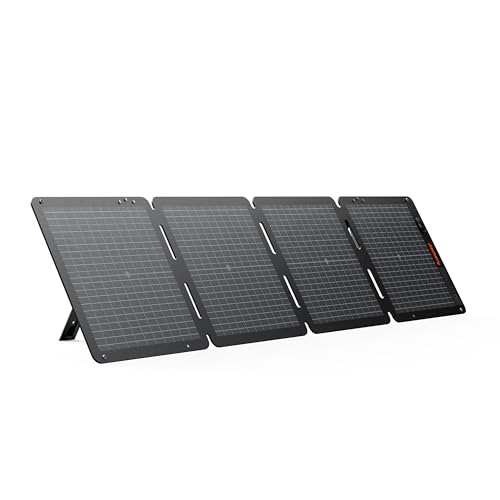
Jackery SolarSaga 100W Air Bifacial Portable Panel
A folding panel you aim at the sun rather than a fixed one you park under a tree. Portable panels out-produce flat roof panels by a wide margin precisely because they can be tilted and moved.
Best for: Renters, rooftop tents, and anyone who parks in shade
Check price
Renogy 200W 12V Solar Panel (N-Type, 16BB)
Twice the output on roughly the same mounting effort as a 100W panel, and fewer roof penetrations per watt. On most van and truck-camper roofs this is the sensible unit size.
Best for: The standard building block of a 200W to 600W roof array
Check price
BougeRV 200W 12V Bifacial Solar Panel (N-Type, 16BB)
Bifacial cells pick up reflected light off the roof surface, which is a real if modest gain on a white or light-coloured vehicle. Treat the rear-side bonus as a few percent, not the marketing figure.
Best for: Light-coloured roofs with an air gap under the panel
Check price
EcoFlow 220W Bifacial Portable Solar Panel (IP68)
The portable panel that pairs directly with an EcoFlow station without an adapter hunt. IP68 rating means it survives being left out through weather, which is how these actually get used.
Best for: Power station owners who want one clean cable
Check pricePrices change often, confirm on Amazon. Products without a direct listing sell mainly through dealers, so those links open a scoped Amazon search. As an Amazon Associate we earn from qualifying purchases.
How much of each should you actually buy?
Work backwards from consumption rather than forwards from roof area, because roof area will happily absorb more panels than your bank can use. A typical build with a compressor fridge, lighting, a roof fan and device charging lands somewhere between 45 and 70 amp-hours a day in summer and rather less in winter, when the fridge works far less hard.
Against 60 amp-hours a day, the seasonal table says a 200W flat roof array covers you in midsummer with a little spare, a 400W array covers you comfortably from late winter through autumn, and nothing reasonable covers midwinter on solar alone. That is the shape of almost every build: solar is a summer solution that becomes a supplement in the cold half of the year. The honest plan is 200W to 400W on the roof, one portable panel of 100W to 220W, and alternator charging to cover the rest.
There is a ceiling worth respecting on the roof side. A charge controller cannot push energy into a battery that is already full, so an oversized array spends the middle of a summer day throttled rather than producing. If your controller history shows the array idling at noon on most days, more panels will change nothing, and the next useful purchase is storage, a larger DC-DC charger or nothing at all. This is the single most common way money gets wasted on a solar build.
On the portable side, one panel is almost always the right number. Two portable panels means two sets of cables to lay out and pack away, and the second one usually stays in the vehicle. Buy one that is large enough to matter, easy enough to deploy that you actually deploy it, and connected with a plug that takes two seconds. Then judge it after a season using the shunt history rather than an impression, because the fair test is how many days it contributed on, not how much it produced on the day you set it up carefully.
Where to go next
- The solar panel mounting guide, for brackets, sealing and layout.
- How to install solar on a van, for the full wiring sequence.
- The solar panel roundup, for the specific panels worth buying.
- MPPT versus PWM, which decides how much of this output reaches the battery.
- Solar versus alternator charging, for the days the sun does not cooperate at all.
Frequently asked questions
Does a portable panel really beat a roof panel of the same size?
In winter and in shade, yes, and by a wide margin. A 100W panel aimed at the sun returns roughly 19 amp-hours a day in midwinter against about 12 from the same panel lying flat on a roof, which is close to 60 percent more. In midsummer the gap narrows to around 12 percent, because a high sun angle means a flat panel is already presenting a reasonable face to it.
Why does a flat roof panel lose so much in winter?
Because a panel produces in proportion to how squarely it faces the sun, and in midwinter the sun stays low. A horizontal panel is presenting a poor angle to that low sun for the whole of a short day. Tilting a panel to roughly your latitude, or a little steeper, recovers most of the loss, which is why a fixed tilt bracket is worth considering even on a permanent roof array.
Will roof panels hurt my fuel economy?
Some, and the rack usually costs more than the panels do. A low-profile panel bonded close to a van roof adds little frontal area, while panels raised on a rack above an SUV or a truck camper add both drag and turbulence. Published figures vary too much by vehicle to quote precisely, but expect a few percent at highway speed, plus wind noise that is loudest in a crosswind.
How much roof load can my vehicle take?
Check the owner manual rather than guessing, and note that dynamic roof load while driving is usually far lower than static load while parked. A 200W panel is roughly 22 to 26 pounds, and the rack it sits on is often heavier than the panels. That combined figure has to fit the dynamic limit, and it sits high above the centre of gravity, so it affects handling more than an equivalent weight in the floor.
How do I stop a portable panel being stolen?
Assume it can be, and plan around that. Do not leave one out at a trailhead or anywhere you are away from the vehicle for a full day. Use a cable lock through the frame as a deterrent rather than as security, and connect it with a genderless 50A connector so it can be unplugged and put away in seconds. The panels most often stolen are the ones left out because packing them up was inconvenient.
Can I run both a roof array and a portable panel?
Yes, and it is the arrangement this page recommends. The simplest approach is a second input on a dual-tracker controller, or a separate small controller for the portable panel landing on the same busbar. Do not parallel a portable panel directly into a roof string of different voltage or current, because mismatched panels in one string drag each other down to the weakest member.
Electrical safety: 12V is low voltage but not low energy. A lithium house battery can push several hundred amps into a short circuit, and undersized or unfused cable is one of the most common causes of vehicle fires in DIY builds. Every circuit must be fused at the source of power, within a few inches of the battery terminal, at or below the ampacity of the smallest conductor it protects. Size cable for voltage drop as well as ampacity, torque terminals to specification, and have a lithium installation inspected by a qualified installer before it carries load. The figures on this page are researched guidance, not a substitute for ABYC E-11 or your component manufacturer's installation manual.
How we choose: we compare published manufacturer specifications, standards documents including ABYC E-11, and verified owner reviews. We do not test gear in person. Vehicle payload, roof load and charging limits vary by model and year, so confirm yours against the door jamb sticker and the owner's manual rather than any number published here.
Totalling your own build weight against your payload? The Overland Build & Power Planner is the paid version of these pages: 8 printable worksheets you fill in with your own numbers, plus the full PDF, $29.